AI in Mobile Apps: How on-device AI is changing user experiences
Introduction
Artificial Intelligence is rapidly transforming mobile applications, not just in the cloud, but right on your phone.
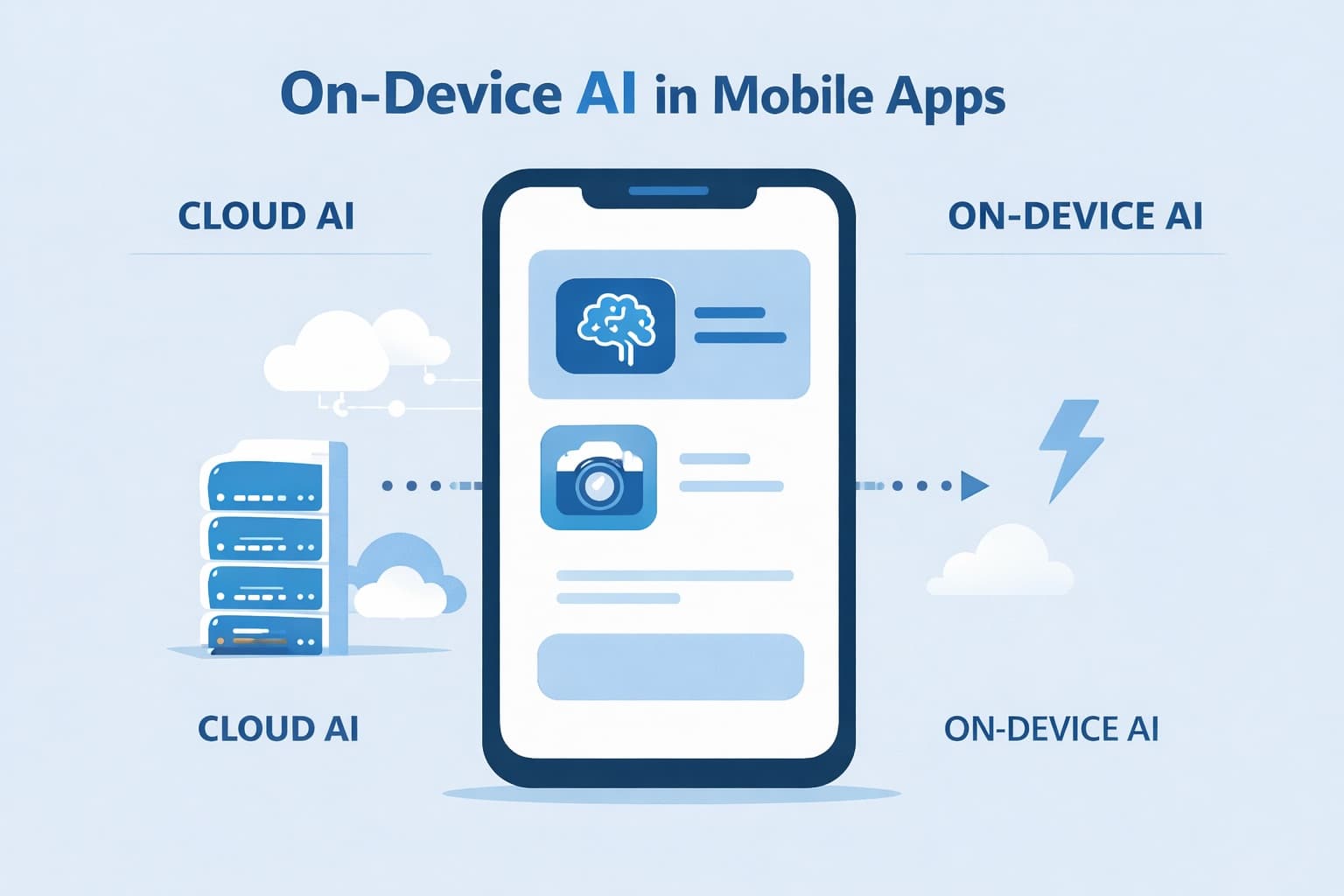
Instead of sending data to a server and waiting for a response, on-device AI runs models locally, unlocking faster responses, stronger privacy, and offline functionality that doesn’t depend on an internet connection.
This shift is redefining what mobile apps can do, moving intelligence closer to users and devices.
Why Run AI Locally?
Mobile apps are no longer just consumers of cloud-based intelligence; they’re now hosts for powerful models running directly on the device.
On-device AI refers to performing inference locally rather than sending data to remote servers. That shift brings three key advantages:
- Privacy: personal data (photos, speech, text) stays on the device.
- Speed: instant responses without network round-trips.
- Offline capability: features continue to work without connectivity.
This unlocks new experiences in everyday apps — from smarter camera effects and real-time translation to conversational assistants and content generation entirely offline.
- On-Device AI Frameworks
Mobile AI is supported by a range of tools that enable models to run directly on devices. These frameworks vary in goals, ecosystem integration, and the types of models they support:
- PyTorch Mobile / ExecuTorch
A PyTorch-centric runtime that lets developers export models via TorchScript or ExecuTorch pipelines for on-device inference. Especially friendly to teams already using PyTorch for training.
- ML Kit
A powerful, free, and easy-to-use mobile SDK from Google that brings on-device machine learning to Android and iOS apps.
- Core ML
Apple’s native machine learning framework optimized for iOS and macOS, with tight Xcode integration and excellent performance on Apple Silicon.
- TensorFlow Lite
A mature, industry-standard on-device ML framework widely used for image recognition, NLP, and custom models on Android and iOS. Includes quantization tools and hardware delegation.
- ONNX Runtime Mobile
A cross-platform execution engine for models converted to the ONNX format, ideal for reusable workflows across multiple ecosystems.
ExecuTorch: A Practical Path to On-Device AI
Several approaches exist for mobile AI, ranging from lightweight neural network runtimes to fully local language inference.
One framework that makes this surprisingly approachable — especially for hybrid apps built with React Native — is ExecuTorch, part of the PyTorch Edge ecosystem.
ExecuTorch enables PyTorch models to run efficiently on mobile hardware by exporting them to optimized binaries and applying quantization to reduce memory footprint and improve performance.
With a declarative API and prebuilt hooks, developers can integrate AI components into apps without deep native or ML infrastructure knowledge.
A Client Use Case: Vision + Language, Fully Offline
To evaluate ExecuTorch in a real mobile context, we developed a feature for a client in the wellness domain that showcases on-device computer vision, running entirely within a React Native app.
The application uses an EfficientNetV2 image classification model executed locally through react-native-executorch to recognize food items from a photo.
Captured images are processed directly on the device, with the model producing classification results that are transformed into an editable list of ingredients. These results then drive the rest of the app’s experience:
- Inventory tracking
- AI-assisted meal suggestions
Those suggestions are generated locally using a small quantized language model (LLAMA3_2_1B) running on-device via ExecuTorch.
All model loading and inference happen entirely on the device, with no server communication. Camera input is sent to the model, top predictions are shown almost immediately, and the UI updates in real time — resulting in a smooth, responsive user experience.
Customizing Models with ExecuTorch
One of ExecuTorch’s strengths is not just running pre-built models on device, but customizing and exporting your own.
Models trained in PyTorch — whether vision, language, or multimodal — can be exported through a straightforward pipeline designed for efficient mobile execution.
Using standard PyTorch export APIs, developers can produce optimized .pte artifacts that run natively on Android and iOS. The pipeline supports:
- Quantization
- Reduced memory usage
- Lower compute requirements
All without rewriting architectures or relying on proprietary formats.
This simplifies experimentation and iteration: teams can train or fine-tune models using familiar PyTorch tooling, then export and deploy them to mobile devices with minimal additional effort — creating a smooth path from research to on-device inference.
Conclusion: Local vs Cloud AI
Modern mobile apps are increasingly capable of running AI models directly on the device, bringing powerful intelligence closer to users.
On-device AI excels when:
- Low latency is critical
- Privacy is a priority
- Offline functionality is required
By processing data locally, apps can respond instantly (crucial for image scanning, voice commands, or live feedback) while keeping sensitive user data entirely on the device.
That said, cloud-based AI still plays an important role. Running on powerful remote infrastructure, cloud AI is better suited for:
- Large-scale models
- Extensive context and reasoning
- Centralized analytics
- Continuously updated services
In practice, the future of mobile AI is hybrid — combining the strengths of both local and cloud intelligence to deliver the best possible user experience.
References
https://executorch.ai/
https://docs.swmansion.com/react-native-executorch/
https://docs.pytorch.org/executorch-overview
https://developers.google.com/ml-kit
AImobileAutomationLLMonDevice
.svg)