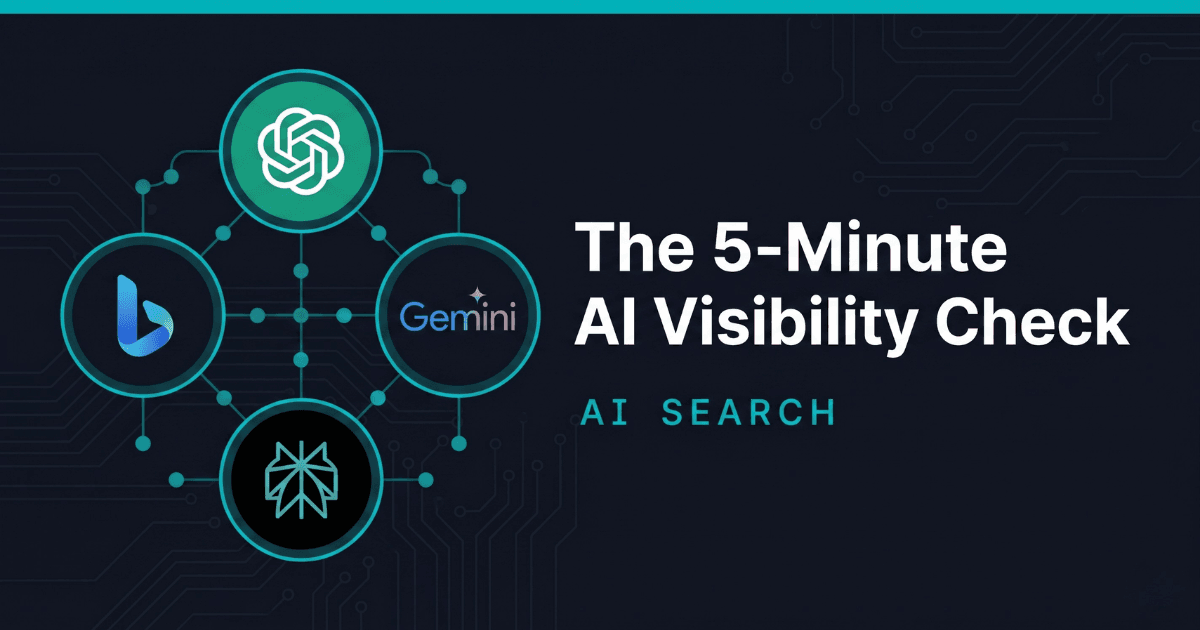
The 5-Minute AI Visibility Check Every Business Should Run
If you've searched for something on ChatGPT lately and noticed it recommended a specific business, product, or service, you've seen AI visibility in action. The businesses showing up in those answers aren't there by accident. They've built the right infrastructure. The question is whether your business has too. Most business owners assume that if they rank well in Google, they're covered. That assumption is increasingly wrong. AI search engines like ChatGPT, Gemini, and Perplexity don't use Google's index to generate answers. They use their own training data, their own crawlers, and their own criteria for deciding which businesses are credible enough to cite. Ranking on page one of Google and being invisible in AI search at the same time is entirely possible, and increasingly common. Here's a five-minute check you can run right now to see where you stand, along with the advanced moves that separate businesses that occasionally appear in AI answers from the ones that get cited consistently. Step 1: Ask ChatGPT about your business directly Open ChatGPT and type: "What do you know about [your business name]?" Read the response carefully. Does it know what you do? Does it have your location right? Is the description accurate and current? If ChatGPT returns nothing, gets your business wrong, or confuses you with a competitor, your brand entity isn't well established in AI systems. The advanced move here is entity optimization. AI systems build a picture of your brand from every mention, description, and reference across the web. Your website, your LinkedIn company page, your Google Business Profile, directory listings, press mentions, and third-party reviews all contribute to that picture. When those sources are consistent and specific about what you do, who you serve, and where you operate, AI systems can confidently represent you. When they conflict or stay vague, AI systems hedge or skip you entirely. Audit your entity signals across every platform and make sure they're all telling the same precise story. Step 2: Ask a buying question in your category Type the kind of question your ideal customer would ask before hiring someone like you. "Who are the best [your service] providers in [your city]?" or "What should I look for in a [your industry] company?" See if your business comes up. If competitors are being cited and you're not, that's the gap AI visibility work closes. The advanced move is topical authority architecture. AI systems don't just evaluate individual pages. They evaluate whether your site demonstrates genuine expertise across a topic. A business that has one good service page competes poorly against a competitor that has that service page plus supporting content covering related questions, comparisons, how-to guides, and case studies. Building a content architecture that signals depth of expertise in your category is one of the highest-leverage long-term investments in AI visibility. Step 3: Check if you're indexed in Bing ChatGPT uses Bing's index for real-time web queries. Go to bing dot com and search your business name and domain. If Bing doesn't have you properly indexed, ChatGPT's real-time search can't find you regardless of how well optimized your site is. Verify in Bing Webmaster Tools, import your Google Search Console data, and submit your sitemap. This takes about five minutes and is one of the fastest fixes available. The advanced move is monitoring your Bing presence actively, not just setting it up once. Bing Webmaster Tools has its own keyword data, crawl reports, and indexing alerts. Treating it as seriously as Google Search Console gives you a direct line of sight into how ChatGPT's real-time queries are finding and interpreting your site. Step 4: Look at your schema markup Schema markup is structured data that tells AI systems exactly what your business is, what it does, who it serves, and where it's located. Without it, AI engines have to guess. You can check yours using Google's Rich Results Test or Schema Markup Validator by pasting your URL and reviewing what comes back. If you see nothing, or only basic page-level schema, there's meaningful work to do. The advanced move is going beyond Organization and WebPage schema. The businesses getting cited most consistently in AI answers tend to have FAQ schema on key pages, Service schema with detailed descriptions, Article schema on blog content, and Review schema with real ratings attached. Each additional schema type gives AI systems more structured signals to work with, and more reasons to trust your site as a reliable source. Schema isn't a one-time install. It's an ongoing layer that should grow as your content grows. Step 5: Check whether you have a schema plugin properly configured Most businesses that have schema at all are running bare minimum coverage. A properly configured schema plugin changes that across the entire site automatically, not just on pages someone remembered to optimize manually. On WordPress, Rank Math Pro is the current standard for AI visibility purposes. It generates schema at the page, post, and site level, supports custom schema types, and integrates with your content in ways that static schema snippets can't match. On Shopify, the platform generates basic product schema natively but leaves significant gaps around reviews, FAQs, and organization-level signals that need to be filled manually or with an app. On other platforms the approach varies, but the principle is the same: schema should be systematic, not page-by-page. The advanced move is auditing not just whether schema exists but whether it's accurate and specific. Organization schema that lists a generic business category instead of a precise service description is nearly as weak as no schema at all. AI systems reward specificity. A schema configuration that names your exact services, your service areas, your founding date, your key people, and your credentials gives AI systems a structured, machine-readable brief on exactly who you are and why you're credible. The metric most businesses are missing All five of these checks give you directional signal, but the metric that ties it together is Share of Model Voice: how often your brand appears in AI-generated answers to the questions your ideal customers are actually asking. Tools like Otterly let you track this systematically by running structured queries and reporting which sources are being cited. Without this measurement layer, you're optimizing without knowing whether the optimization is producing citations. If you want a scored baseline before deciding where to focus, Rivetline offers a free AI Visibility Report that analyzes any URL in about 75 seconds and scores your site across structured data, semantic clarity, authority signals, and competitive presence. Find us on this directory to get started. AI search isn't coming. It's here. The businesses showing up in those answers over the next 12 months are the ones building the infrastructure today.