Lead generation for a cloud-based design and engineering solution
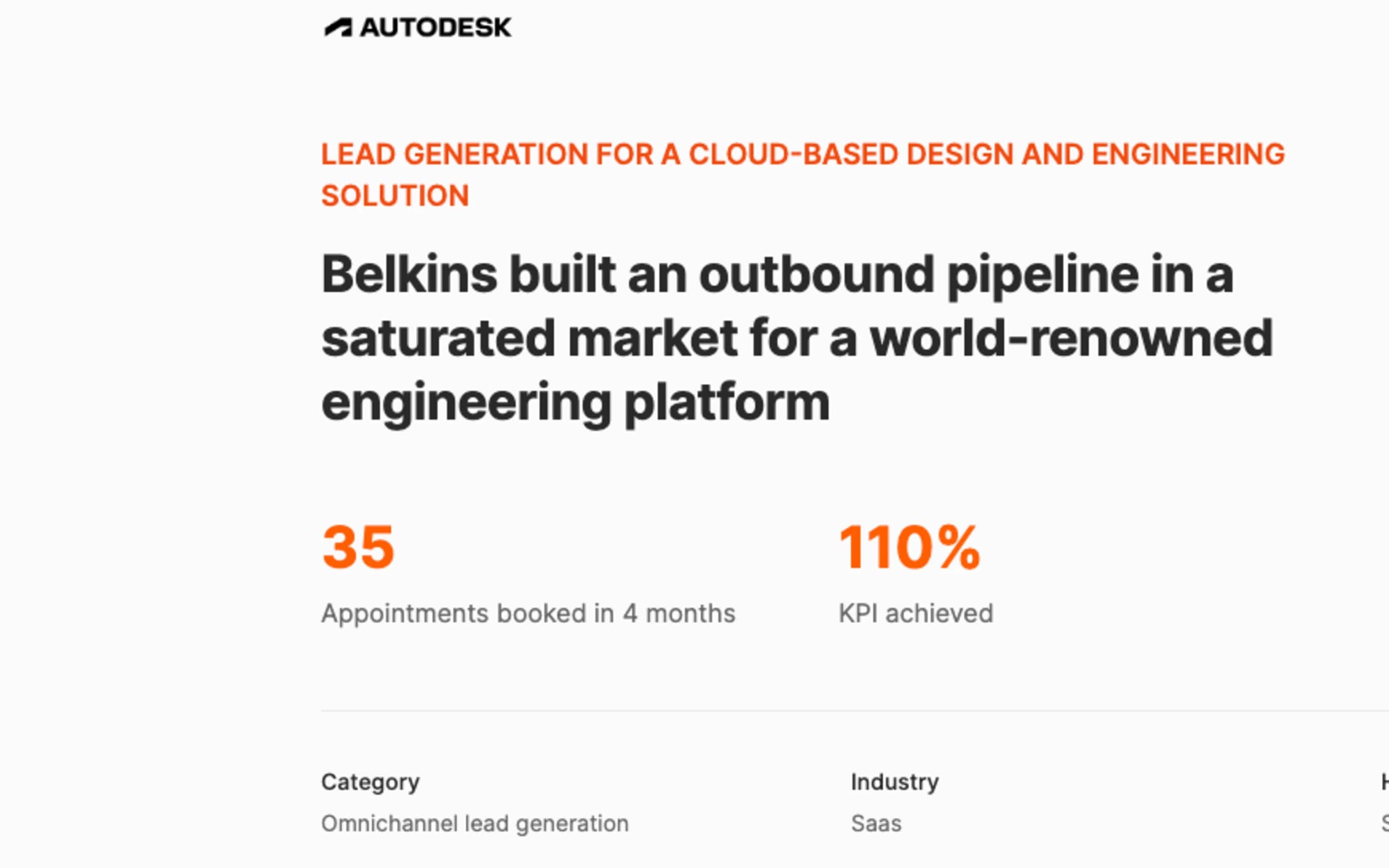
Belkins built an outbound pipeline in a saturated market for a world-renowned engineering platform
Challenge
Outbound at scale in a market where everyone already has a tool Autodesk Fusion differentiates itself as a unified cloud platform integrating CAD, CAM, CAE, and data management. While traditional competitors typically silo design and manufacturing, Fusion bridges the gap, managing the entire lifecycle from initial concept to final production output.
The target sector, furniture and consumer product manufacturing, is characterized by high tool standardization. Most prospects are already entrenched in legacy ecosystems such as SolidWorks. The challenge was not to capture existing demand, but to create it. The outbound strategy focused on engaging companies that were not actively searching for new software and initiating strategic conversations with manufacturers unaware of the advantages of a unified, cloud-based environment.
There were 4 strategic constraints in this partnership:
Absence of dedicated outbound infrastructure. Autodesk’s internal sales team was optimized for inbound lead capture and account management. Without a dedicated function for systematic cold outreach, the sheer volume of 8,000 unique accounts created a manual bottleneck preventing efficient lead processing. ICP misalignment. The initial 8,000-account master list lacked quality assurance and created significant ICP misalignment. It contained mostly distributors, retailers, and other entities falling outside the target profile. No competitive messaging framework. There was no existing playbook for proactive market disruption. The program required a foundational messaging architecture to position Fusion against entrenched competitors. Two distinct personas with different technical needs. Design leaders and engineering leaders both used Fusion, but for different parts of the workflow. Reaching them with identical messaging would have meant underperforming with both.
Solution
Infrastructure first, then outreach built to survive real objections
Results
Results delivered: Appointments in a market that already had a preferred vendor Autodesk partnered with Belkins to build a high-capacity outbound engine to drive the pipeline for its product Fusion in the manufacturing sector. As this represented Autodesk’s first foray into large-scale outbound sales, they required not just an execution arm, but a data-driven partner capable of collaborative experimentation and strategic scaling.
The database they brought was large (approximately 8,000 leads) but raw, sourced through a partner and AI-enhanced tools, with no validation layer and limited ICP filtering. A significant portion of contacts were either outside the target persona or no longer valid.
Results from almost 4 months of active outreach included:
Booked 35 appointments with sales-ready prospects. Built a new omnichannel outreach infrastructure (across email, LinkedIn, and cold calling). Developed a competitive positioning framework to engage prospects already using competitors’ tools. Built persona-specific messaging across three channels, with a 14.3% reply-to-appointment conversion rate from those who responded. From the raw database of ~8,000, leads were validated in batches. Around 1,000 could be verified as valid, so significant research and re-enrichment were required before outreach could even begin.
What we learned
Research quality > Lead volume. Database size is a vanity metric; validation is an engine. Spending time upfront on verifying role-appropriate contacts isn’t overhead. It’s the difference between a high-conversion campaign and a blocked sender reputation.
Technical specificity over “talking points.” Engineers and design directors ignore generic “we’re better” messaging. Success in this program came from the technical context:
Citing the $2,000/year SolidWorks maintenance cost. Addressing the 30% of time wasted on manual data handling. Highlighting Fusion’s native PDM vs. competitors’ paid add-ons. 3. Non-negotiable persona splits. Design and engineering leaders use the same tool but buy it for different reasons. Running identical sequences is a recipe for irrelevance. Messaging must be split by persona to maintain each stakeholder’s attention.
“Second angle” recovery. Don’t treat non-responders as dead leads. We converted a significant portion of the initial no-shows by pivoting to a second, PDM-focused campaign. Always plan a fallback narrative before the first round ends.
Brand opens doors; process closes deals. Autodesk’s brand recognition provided immediate permission to speak. However, meetings only converted when the sequences transitioned from brand awareness to pain-point solving.