AEO vs SEO: What’s the Difference and Why You Need Both
Search is changing fast.
For years, SEO was the main way businesses improved online visibility. You optimized pages, targeted keywords, earned links, and worked to rank in search results. That still matters. A lot.
But now, more people are getting answers without clicking through ten blue links. They are seeing AI Overviews in Google, asking questions in ChatGPT, using Perplexity, and relying on search experiences built to deliver direct answers first. Google’s own guidance says its AI search features are part of Search and that the same core approach still applies: create content that helps people and makes it easy for Google to understand your pages.
That is where AEO comes in.
AEO, or Answer Engine Optimization, is also often referred to as GEO (Generative Engine Optimization). In practice, both terms are used to describe strategies that help content appear in AI-generated answers, summaries, and conversational search experiences. Key Takeaways
SEO helps your website rank in traditional organic search results. AEO helps your content get selected for direct answers in search engines, AI summaries, and assistant-style search experiences. SEO is still foundational because strong technical health, helpful content, and clear site structure support visibility across both classic and AI-enhanced search. AEO focuses more heavily on question-based content, concise answers, structured formatting, and entity clarity. Businesses that want stronger search visibility should not replace SEO with AEO. They should integrate both.
What Is SEO?
SEO, or search engine optimization, is the process of improving your website so it can rank better in search engines like Google.
Traditional SEO usually focuses on things like:
keyword targeting search intent alignment title tags and meta descriptions internal linking technical site health local SEO signals backlinks and authority useful, original content
The goal is to help search engines understand your pages and trust them enough to rank them for relevant searches.
SEO is still essential because it helps your website earn visibility for commercial, informational, and local queries. It also creates the foundation that supports newer search experiences. Google’s current documentation on AI features specifically says to focus on the same kinds of things that already help with Search: unique, valuable content and a great page experience.
What Is AEO?
AEO stands for Answer Engine Optimization.
It is the practice of optimizing content so it can be pulled into direct-answer environments, such as:
Google AI Overviews voice search results featured snippets AI assistants conversational search tools
Instead of only trying to rank a page, AEO aims to help your brand become part of the answer.
That means your content needs to be easy to extract, easy to trust, and easy to understand. Clear definitions, concise summaries, scannable headings, strong supporting detail, and structured data all help machines interpret what your page is about. Google states that structured data helps it understand page content and information about the entities mentioned on the page.
AEO vs SEO: What’s the Main Difference?
The simplest difference is this:
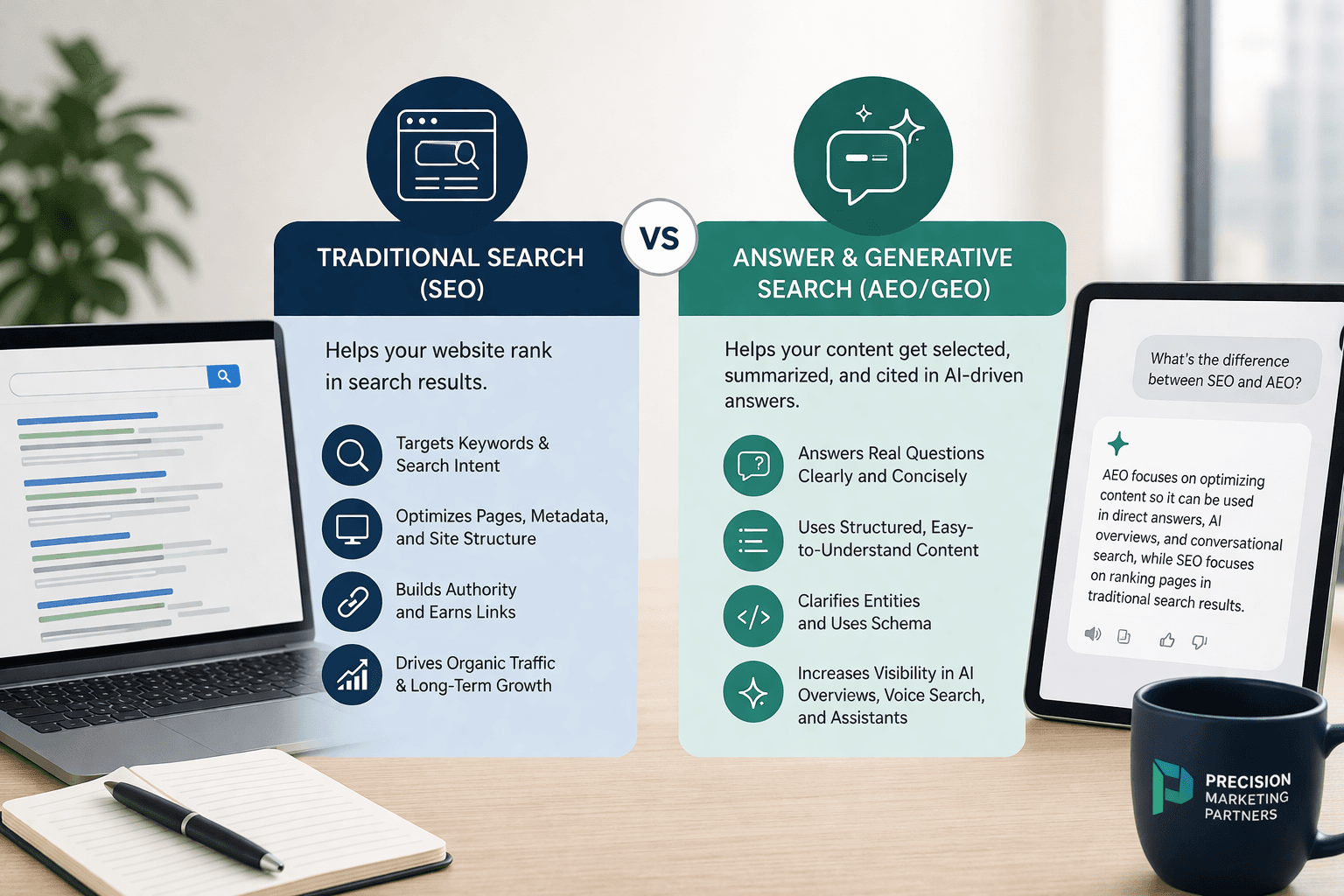
SEO helps you rank. AEO helps you get quoted, summarized, or cited.
SEO is largely about improving your visibility in search results pages. AEO is about improving your chances of being used in direct answers.
They overlap, but they are not identical.
SEO usually prioritizes:
ranking improvements keyword coverage organic traffic growth crawlability and indexability topical authority link equity
AEO usually prioritizes:
direct answers to specific questions concise summaries near the top of the page content structured for extraction entity clarity FAQ-style formatting schema and contextual signals answer-first copy that still leads into deeper detail
AEO does not replace SEO. It builds on it.
Why SEO Still Matters in an AI Search World
Some businesses hear about AI search and assume traditional SEO is no longer important. That is a mistake.
Google’s guidance on AI features makes it clear that AI-driven experiences still rely on the broader Search ecosystem. Helpful content, strong page quality, and clear site structure still matter. Google also says its automated ranking systems are designed to prioritize helpful, reliable, people-first content.
If your website has weak content, poor organization, thin service pages, or confusing messaging, AEO will not save it.
In fact, most successful AEO work starts with good SEO fundamentals, including:
clear topical relevance strong service pages fast, usable website experience consistent internal linking well-organized content hubs trustworthy brand signals
Why AEO Matters More Than Ever
Search behavior is becoming more conversational.
Users are no longer only typing short phrases like “marketing agency Raleigh.” They are asking full questions like:
What is the difference between SEO and AEO? Which marketing strategy helps businesses show up in ChatGPT? How do I optimize my website for AI search?
Google says AI Overviews provide AI-generated snapshots with links for users who want to dig deeper. That means being visible now is not just about ranking in a list. It is also about being one of the trusted sources that helps form the answer.
For local and small business brands, this creates a new opportunity. If your content is specific, trustworthy, well-structured, and clearly tied to your services and geography, you have a better chance of being surfaced in answer-driven experiences.
How AEO and SEO Work Together
The strongest content strategies use both.
Here is what that looks like in practice:
- Start with search intent
Target real questions, real service needs, and real decision-stage queries.
- Build a strong SEO page
Use clear headings, relevant keywords, internal links, local context, optimized metadata, and useful depth.
- Add answer-first elements
Include a concise summary, direct definitions, FAQ sections, comparison tables if appropriate, and short responses to common questions.
- Clarify entities and context
Make it obvious who you are, what you do, where you serve, and how topics relate.
- Use schema where it fits
Structured data can help search engines understand your page more clearly. Google explicitly documents this in its structured data guidance.
- Keep content people-first
Google warns against using generative AI to produce large amounts of low-value content and says content should meet Search Essentials and spam policies.
That combination gives your content a better chance to rank in organic search and perform well in AI-driven answer environments.
AEO vs SEO for Small Businesses
For small businesses, this is especially important.
You may not have the biggest brand, the largest ad budget, or the highest domain authority in your market. But you can still compete by publishing content that is:
highly relevant locally specific clearly organized genuinely helpful easier for search engines and AI systems to interpret
For many businesses, the real win is not choosing one approach over the other. It is building content that performs across both.
How We Approach AEO and SEO at Precision Marketing Partners
At Precision Marketing Partners, we do not treat SEO and AEO as separate silos.
We build content strategies that help businesses:
rank in traditional search improve local visibility answer real buyer questions strengthen topical authority become easier for AI tools to understand turn search visibility into leads
That means combining classic SEO best practices with modern content structures that support AI summaries and answer-driven discovery.
It also means focusing on what Google continues to reward: helpful, reliable, people-first content.
So, Is It AEO vs SEO?
Not really.
The businesses that will perform best in search are the ones that understand this shift early:
SEO gets you into the conversation. AEO helps you become the answer.
If your strategy only focuses on rankings, you may miss visibility in AI-driven experiences. If your strategy only focuses on answers without solid SEO fundamentals, you may never build enough authority to be included.
The right approach is both.
Final Thoughts
Search is not disappearing. It is evolving.
Traditional SEO still matters because it builds the visibility, trust, and site quality that search engines rely on. AEO matters because more users are interacting with search in ways that prioritize immediate answers, AI summaries, and conversational results.
At Precision Marketing Partners, we help businesses adapt to both realities. That means building content that is discoverable, useful, structured, and persuasive whether someone finds you through a search result, an AI Overview, or an answer engine.