Vibe Coding Cleanup: How to Fix an AI-Generated Codebase Before It Breaks
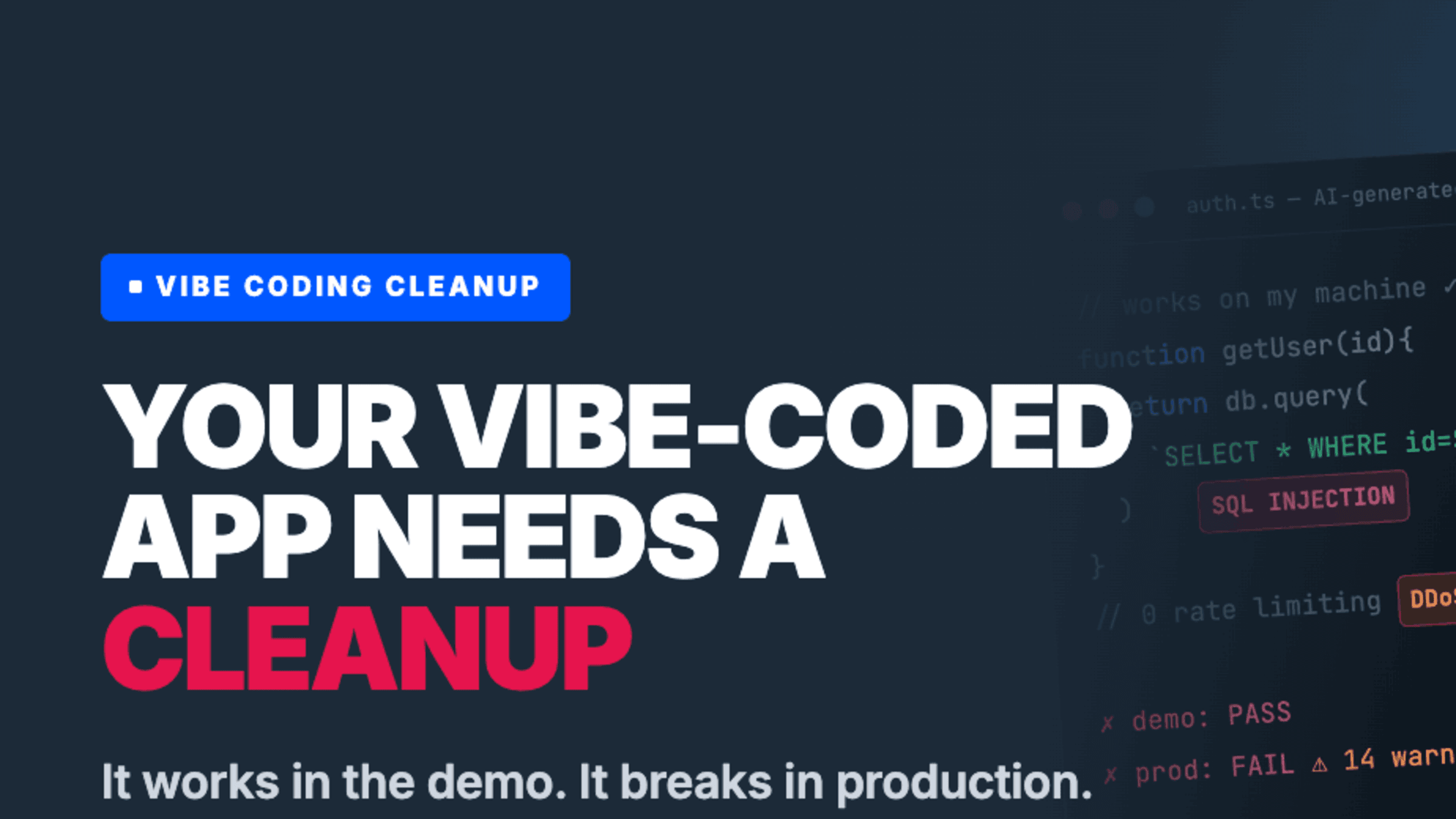
Vibe Coding Cleanup: How to Fix an AI-Generated Codebase Before It Breaks in Production
What is vibe coding cleanup?
Vibe coding cleanup is the structured process of auditing, refactoring, and hardening a codebase that was generated almost entirely by AI coding tools, so it can survive real production traffic. The term "vibe coding" describes building software by prompting an LLM in tools like Cursor, Lovable, v0, Bolt, or Replit and shipping whatever it returns without an engineer fully reading it. That workflow gets a demo running in an afternoon. It also accumulates a specific class of defects that only surface under load, at the edges, or on the second feature change. Cleanup is the remediation layer between "it worked in the demo" and "it holds up with real users, real data, and real money moving through it."
Why do vibe-coded apps break in production?
Vibe-coded apps break because AI optimizes for code that runs once, not code that holds up over time. An LLM will happily produce a working endpoint with no input validation, secrets hardcoded in the client bundle, an unindexed query that is fine on 50 rows and fatal on 50,000, and authorization checks that exist on the happy path but not on the three routes the model forgot. None of this fails in the demo. It fails when a real user sends a malformed payload, when the table grows, or when someone hits an endpoint the UI never exposed. Industry-wide signals back this up: GitClear's multi-year analysis of more than 200 million changed lines of code shows code churn climbing and duplicated, copy-pasted blocks rising year over year, while refactoring and code reuse decline. More AI in the loop is correlating with measurably messier repositories, not cleaner ones.
What are the most common vibe coding mistakes?
The defects cluster into five recurring categories, and almost every vibe-coded project we audit hits at least three of them.**Security holes.**Exposed API keys and secrets in client code, missing or partial authorization, no input sanitization, and SQL or prompt injection surfaces the model never guarded.**Silent data risk.**No transactions around multi-step writes, missing foreign-key and uniqueness constraints, and no migration strategy, so the first schema change corrupts existing rows.**Performance debt.**N+1 queries, unindexed lookups, no caching, and synchronous calls that block the request thread. Fine at demo scale, linear-to-quadratic blowup at real scale.**Architectural drift.**Duplicated logic across files, no separation of concerns, business rules scattered through the UI layer, and inconsistent patterns that make the next change exponentially more expensive.**Zero safety net.**No tests, no error handling, no logging, no monitoring. When it breaks in production, nobody knows why, and there is nothing to roll back to.
How do you audit a vibe-coded codebase?
A proper vibe code audit is an engineering review, not a linter pass. It inspects the codebase across the five risk categories above plus dependency health, secret management, and deployment configuration, then ranks every finding by blast radius: what fails first, what fails worst, and what is one bad input away from a breach. The output is not a vague "your code needs work." It is a prioritized remediation list that separates ship-blockers from cosmetic debt, with an estimate attached to each. This is exactly what Valletta.Rescue delivers as a fixed-price vibe code audit starting at $199: a senior engineer reads your AI-generated code, documents the concrete risks, and gives you a remediation plan you can act on or hand to any team. Fixed price, no time-and-materials surprise.
Can you fix a vibe-coded project, or do you rebuild from scratch?
In most cases you fix it, because the AI usually got the structure roughly right and the data model partly right; the failures are in the gaps, not the foundation. Remediation means hardening what exists: adding the missing auth and validation, wrapping multi-step writes in transactions, indexing the queries that will not scale, extracting duplicated logic, and bolting on the tests, error handling, and monitoring that were never there. A full rebuild is only warranted when the architecture is structurally wrong, when the data model cannot represent the real domain, or when the codebase has drifted so far that every change touches ten files. The audit is what tells you which situation you are in, and that distinction is the difference between a few days of cleanup and a multi-week rebuild. "Fix" and "build from scratch" are different jobs with different prices, and you should never be quoted one as if it were the other.
When should you bring in engineers for AI code remediation?
Bring in engineers the moment a vibe-coded app stops being a prototype and starts touching real users, real payments, or real personal data. The pattern we see in every audit of AI-built software is consistent: the model writes the bulk of the code, and an engineer handles the roughly 30 percent where production actually breaks. That last slice is the authorization edge case, the migration that does not corrupt data, the query that scales, the failure path that logs instead of crashing silently. AI coding tools are genuinely good at the first 70 percent and that is real leverage. The mistake is assuming the remaining 30 percent does not exist because the demo looked finished. Treat the LLM as a fast collaborator, not an unsupervised one, and keep an engineer in the loop before launch, not after the incident.
The honest summary: vibe coding got you to a working demo fast, and that is a real win. Vibe coding cleanup is what turns that demo into something you can put real users on without waking up to an incident. Get the audit, fix the 30 percent that breaks, and ship with a safety net under it.