Everyone's photos. One question: whose is whose?
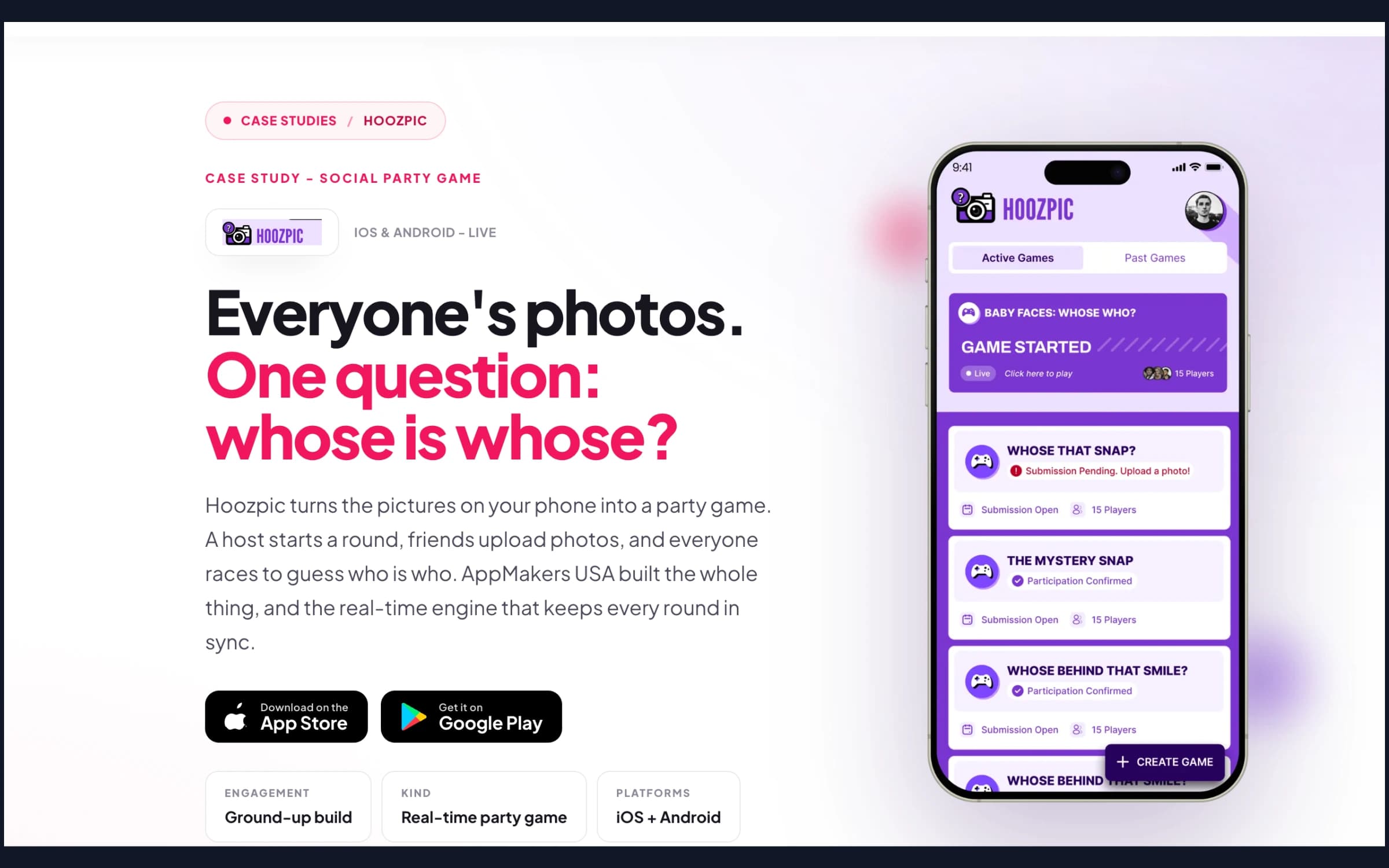
Hoozpic is a real-time social party game where a host starts a round, friends upload photos and captions, and everyone races to guess whose photo is whose. AppMakers USA built the whole app from the ground up for iOS and Android, including the real-time engine that keeps every round in sync.
The core engineering challenge was scale, not gameplay. Instead of setting a timer for every individual game (which breaks down across multiple servers and restarts), they built a scheduler that ticks every ten minutes and sweeps every game to its next state in bulk, stateless database queries. This makes the whole system self-healing: a missed tick just gets caught on the next pass, and there's nothing to lose on a restart.
Two other design choices kept things simple and cheap: a "sent-ledger" that tracks which reminders have already gone out so players never get duplicate notifications, and short-polled chat that uses the message ID itself as a cursor instead of maintaining sticky websockets.
The app is live on both stores and still shipping updates, with the latest release adding in-game chat and new game modes.
Challenge
Hoozpic needed a real-time party game that felt effortless to play (create a round, upload photos, guess whose is whose, see results) but had to work reliably at scale, across thousands of simultaneous games running on multiple servers.
The core technical problem was timing: each game is a small state machine moving through submission, lobby, live guessing, and results. The obvious approach, setting a timer for every individual game, breaks down once you're running more than one server. Clocks drift, servers restart, and timers get dropped or duplicated, leaving the team babysitting thousands of dangling jobs.
Solution
AppMakers USA replaced per-game timers with a single stateless scheduler tick every ten minutes. That one tick sweeps every game to its next state using bulk updateMany database queries, keyed on dates rather than individual timers. Since the state changes are stateless and idempotent, the job is safe to run twice, and a missed run simply heals itself on the next tick, with no per-game state ever at risk.
Two more design choices supported that core engine:
Notifications: Instead of trusting the scheduler not to double-send reminders, they kept a small "sent-ledger" row per game-and-reminder, so each pass only sends what hasn't gone out yet. No locks needed. Live chat: Rather than sticky websockets across autoscaling servers, they used short polling where the message ID itself (since IDs sort by time) acts as the cursor for "anything newer than this." No extra indexes, cheap to deploy.
The result is a real-time system that scales across any number of servers and games without per-game babysitting, and recovers on its own from restarts or missed ticks.
Results
- Shipped on both stores: live on iOS and Android, still shipping updates, with the latest release adding in-game chat and new game modes
- Self-healing by design: the whole game clock runs on stateless bulk sweeps, scaling across servers for free and recovering automatically after a restart or missed tick
- Serverless-cheap real-time: short-poll chat and a notification ledger deliver the live feel without sticky sockets or dedicated realtime servers, keeping running costs low
Project Details
2025