AI-Powered Document Processing for Logistics Operations
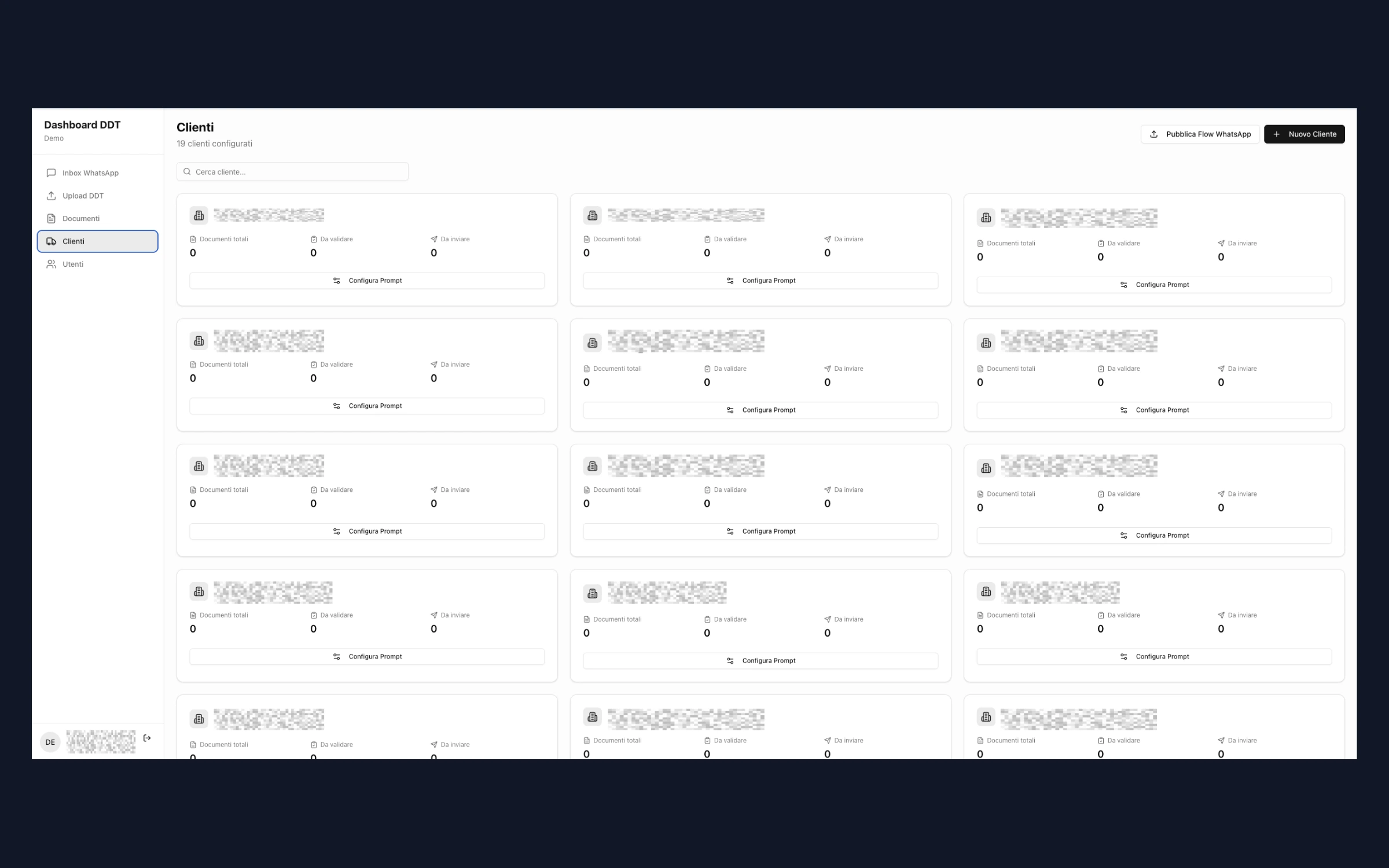
Mea World designed and validated an AI-powered document processing workflow for a logistics company handling delivery documents and orders received through fragmented channels and formats. The proof of concept combined document acquisition, OCR, semantic data extraction, consistency checks and human validation. Its purpose was to determine whether unstructured operational documents could be transformed into reliable, structured data ready for integration with the company’s existing systems. Mea World covered process analysis, AI workflow design, prototyping, validation logic and the technical roadmap toward production.
Challenge
The company received operational documents through different channels, including images, PDF files and messaging-based exchanges. Information had to be manually read, interpreted and transferred into internal systems. Document layouts were not always consistent, and some fields required contextual interpretation rather than simple character recognition. Missing values, conflicting information and variations between suppliers created exceptions that could not safely be handled through rigid automation alone. The challenge was to reduce repetitive manual processing while preserving control over uncertain or incomplete data and preparing a workflow suitable for future integration with the company’s operational software.
Solution
Mea World began by mapping the existing document flow, identifying the required fields, the most frequent document variations and the exceptions that required operator review. We then developed a focused proof of concept that:
acquired delivery documents and orders from representative digital sources; applied OCR and AI-assisted semantic extraction; converted document content into structured fields and line items; checked the consistency of related information; flagged missing, uncertain or conflicting values; presented exceptions to a human operator for validation; prepared normalized outputs for future integration with an ERP or logistics management system. Instead of treating AI as an autonomous replacement for the operator, the solution used a human-in-the-loop approach. High-confidence information could move through the workflow, while uncertain cases remained visible and reviewable.
Results
The proof of concept demonstrated the technical feasibility of transforming heterogeneous logistics documents into structured and reviewable operational data. The project produced:
a working document acquisition and extraction workflow; a structured output model for document fields and line items; validation rules for related and potentially conflicting data; an exception-management process for human review; a clearer understanding of document variability and integration requirements; a technical foundation for planning the production phase. The validation phase also made the boundaries of automation explicit: standard documents could follow a repeatable workflow, while ambiguous or incomplete cases required controlled operator intervention.
Process Discovery
Before building the prototype, Mea World analyzed how documents entered the organization, which information was required by the operational team and where manual interpretation was still necessary. This discovery phase was used to define the test perimeter, representative document samples, acceptance criteria and the distinction between automatically processed cases and exceptions requiring review.
Human-in-the-Loop Validation
The system was designed to support operators rather than hide uncertainty. Extracted information could be reviewed, corrected and approved before entering downstream systems. This approach made the workflow more appropriate for operational documents where a plausible but incorrect value could affect orders, deliveries or administrative processes.
Path to Production
The proof of concept was intentionally separated from the production implementation. The validation phase identified the additional requirements needed for deployment, including system integrations, access controls, monitoring, document retention, exception handling and operational support.
Project Details
2026