Immersive Ferry Fire Safety Simulation for Critical Crew Decisions
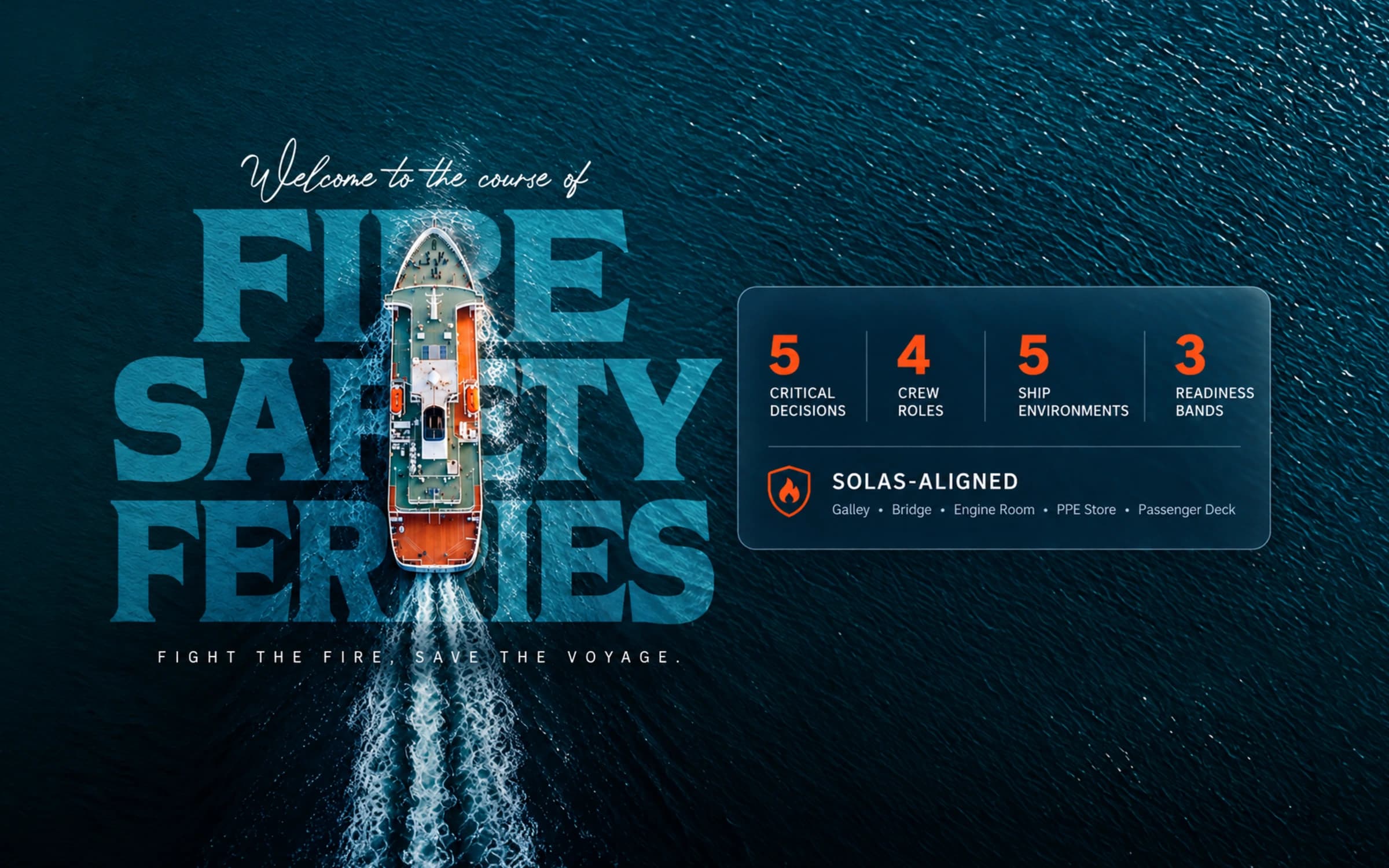
Qquench designed an immersive fire-safety simulation for a UN-affiliated global maritime training institution. The experience places maritime officers, crew members, inspectors and safety managers inside a domestic ferry crossing where a routine galley alarm develops into an escalating operational emergency. Instead of presenting regulations as a conventional compliance course, the simulation asks the learner to observe the vessel, guide four crew roles and make five connected decisions across the galley, bridge, engine room, PPE store and passenger deck. A 360-degree inspection develops spatial awareness, while consequence-based branching shows how early choices affect later options. Three score bands - Ready to Sail, Caution Advised and Critical Risk - trigger different remediation paths. The programme demonstrated Qquench's ability to translate SOLAS-aligned safety requirements into credible, visually immersive decision practice and resulted in Qquench being selected as a preferred vendor by the institution.
Challenge
The institution needed to strengthen fire-response judgement among maritime professionals, not simply test whether they could recall procedures. Traditional safety modules could explain alarm protocols, fire-suppression agents, ventilation controls, personal protective equipment and passenger movement, but they could not reproduce the pressure of noticing hazards and acting in the correct sequence while a situation was escalating. The learning experience also had to be credible to professionals familiar with real vessels. Generic stock photography, clip-art characters or isolated multiple-choice questions would weaken trust and reduce the seriousness of the decisions. The simulation therefore needed accurate vessel environments, recognisable crew responsibilities and a coherent operational sequence across multiple locations. A further challenge was to convert SOLAS-aligned technical content into a decision experience without reducing it to a regulation quiz. The learner had to recognise an overdue extinguisher, an untested detector panel, an open ventilation damper and a propped galley door; raise and verify the alarm in the correct order; isolate power and airflow; select an appropriate fire-suppression agent and PPE; and manage passenger movement. Each choice needed to influence what happened next.
Solution
Qquench created a narrative-first simulation structured around one ferry, one crossing and five critical decisions. The learner guides four distinct roles - inspector, master, chief engineer and passenger liaison - with each decision assigned to the person best positioned to act. The opening interaction is a 360-degree galley inspection. Rather than answering a question immediately, the learner explores the space and identifies four safety issues before sailing. This turns observation into a trainable behaviour. The scenario then moves through the bridge, engine room, PPE store and passenger deck as the fire develops. Decisions are sequential: missed hazards and delayed actions reduce the options available later in the crossing. Qquench designed photorealistic vessel environments, AI-assisted crew illustrations, role-specific dialogue and an animated voyage dashboard. The learner's cumulative decision quality is expressed through the crossing itself rather than only as a percentage. Green, orange and red score bands provide confirmation, targeted knowledge checks or critical-risk remediation. Historical context from the 1994 Baltic ferry disaster establishes the professional stakes without turning the experience into a fear-based narrative.
Results
The simulation converted a regulation-heavy fire-safety brief into an immersive, consequence-based learning experience that trains observation, judgement, escalation and coordinated crew response.
- Qquench was selected as a preferred vendor by the global maritime training institution based on the programme.
- The institution initiated discussions on a broader multi-module fire-safety curriculum for domestic and international ferry operators.
- The final architecture connected five critical decisions across five vessel environments and four operational roles.
- A 360-degree galley inspection trained spatial hazard recognition before procedural questioning began.
- Three score bands delivered differentiated remediation rather than giving every learner the same linear experience.
- The experience was designed for desktop, tablet and mobile interaction, including gyroscope-enabled panoramic viewing on supported mobile devices.
Learning Architecture
The crossing operates as both the narrative spine and the assessment mechanism. Five decisions unfold in sequence, and early actions change the conditions available later. The learner does not receive an isolated score after each question; instead, the consequences accumulate across the voyage. This architecture measures decision quality under evolving conditions rather than short-term recall.
Regulatory and Operational Alignment
Every decision was grounded in maritime fire-safety principles, including alarm sequencing, CO2 or water-mist selection for a galley oil fire, ventilation and damper control, power isolation, PPE requirements and managed passenger routing. Technical content was embedded in operational situations so compliance became something the learner practised rather than something they merely read.
Immersive Experience Design
The simulation uses a 360-degree galley, photorealistic vessel environments, distinct crew identities, voiced dialogue and an animated voyage dashboard. Visual fidelity was treated as an instructional requirement because experienced maritime professionals must recognise the environment and believe the operational context before they will invest in the decisions.
Adaptive Remediation
Performance is grouped into Ready to Sail, Caution Advised and Critical Risk bands. Strong performers progress with confirmation, while learners in the orange and red bands receive targeted knowledge checks or critical consequence explanations. The remediation therefore responds to cumulative decision quality instead of repeating the same content for every learner.
Technologies & Tools
Project Details
2025
4 weeks
$25K – $50K
4 people