Case Study: Launching a Branded EV Charging Network in Queensland, Australia
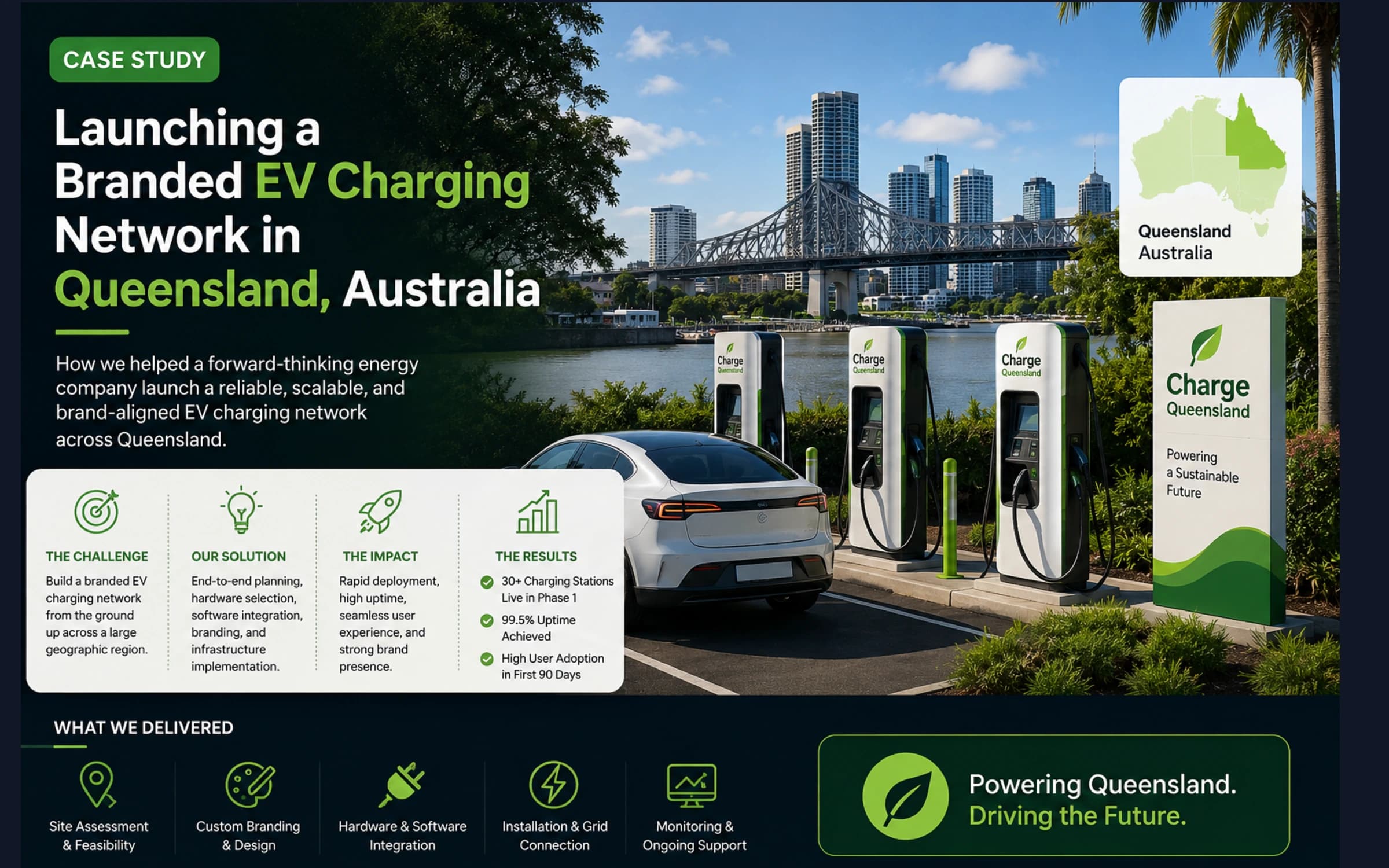
In September 2025, we were approached by a Queensland-based entrepreneur preparing to enter Australia's fast-growing EV charging market. Our client, operating under the working name Voltway Charging, had already secured site access across several commercial and residential locations along the Brisbane–Gold Coast corridor and had a clear go-to-market plan — but no software platform to actually run the network. With a competitive window opening as EV adoption accelerated across South East Queensland, the client needed a fully branded, compliant, and revenue-ready charging management platform, and needed it fast.
We delivered a complete white-label EV Charging Station Management Software (CSMS) solution, covering real-time station monitoring, OCPP-compliant hardware integration, automated payments, and a driver-facing mobile experience — all under the client's own brand. The project moved from initial discovery call to a live public network in just under nine weeks, with the client's first chargers going live in November 2025, well ahead of the 12–18 month timeline a fully custom build would typically require.
Challenge
Australia's EV charging infrastructure market was expanding quickly through 2025, driven by rising EV sales, state government incentives, and growing pressure on commercial property owners to offer charging as a standard amenity. Queensland in particular was seeing strong momentum, with new charging sites opening across shopping centres, apartment complexes, and transport hubs throughout the greater Brisbane region. Our client saw a genuine opportunity to establish an early, branded presence in this space before larger national operators consolidated the market — but building the software layer from scratch presented several serious obstacles.
A hard deadline with no room for a lengthy build. The client had already negotiated site agreements with three initial commercial property partners, each with their own opening timelines tied to broader development schedules. Missing those windows meant losing the sites entirely to competing operators or facing costly renegotiation. A traditional custom software build, typically running twelve to eighteen months from specification to launch, simply wasn't compatible with the client's committed timeline.
Compliance requirements the client's team wasn't equipped to navigate alone. Operating a charging network in Australia meant supporting OCPP-compliant hardware from multiple vendors, since the client's site partners had already selected chargers from different manufacturers based on prior procurement decisions. It also meant building a payment and billing system that could handle Australian consumer payment expectations — card, digital wallet, and account-based billing for fleet and commercial customers — while meeting PCI DSS standards for handling payment data securely. The client's team had strong commercial and property relationships but no in-house engineering capacity to build or evaluate this kind of compliance-sensitive infrastructure.
A need to support very different user types from day one. The three initial sites represented three distinct use cases: a shopping centre car park serving casual, walk-up drivers; a residential apartment complex needing simple, resident-only billing tied to individual units; and a logistics depot requiring fleet-level account management, scheduled charging windows, and centralized reporting for a small delivery fleet. A generic, one-size-fits-all charging app wouldn't serve all three use cases well, and building three separate systems wasn't commercially viable for a first-time operator.
Investor and partner expectations around professionalism and scale. The client was in active conversations with a regional investor group to fund expansion beyond the initial three sites, and needed a platform that looked and operated like an established, professional network from the outset — not a minimum-viable prototype — in order to support those conversations credibly.
Uncertainty about future roaming and interoperability requirements. With Australia's EV charging sector still consolidating, the client was aware that partnering or interoperating with other regional charging networks could become commercially important within the following year, but didn't want to commit to a platform that would need to be rebuilt to support that later. We needed a platform that could launch fast, handle multiple hardware vendors and use cases from day one, meet Australian payment and data compliance expectations, and present a professional, investor-ready face to the market — without asking the client to spend the better part of a year and a substantial capital outlay building it from the ground up.
Solution
We began with a discovery call in the first week of September 2025, where our senior consultant walked through the client's site portfolio, hardware commitments, target user segments, and timeline. Rather than proposing a custom build, we recommended our white-label EV charging station management platform as the right fit — a production-tested CSMS that could be configured, branded, and deployed against the client's specific requirements within a fixed timeline, rather than engineered from scratch.
Branding and platform configuration. Within the first week after contract signing, we onboarded the client's brand identity — logo, colour palette, and domain — across the admin dashboard, driver-facing app, and CPO operator interface, so that from a driver's or investor's perspective, the platform read as a fully in-house Voltway Charging product rather than a third-party white-label solution.
Multi-vendor hardware integration. Because our platform ships with native OCPP 1.6 and 2.0.1 support, we were able to integrate the specific charger hardware already committed to each of the client's three sites without requiring custom integration work per vendor. This meant the shopping centre's chargers, the apartment complex's chargers, and the depot's fleet chargers could all be managed from a single unified dashboard, regardless of which manufacturer supplied each unit.
Configuring three distinct operating models on one platform. We used the platform's multi-tenant and role-based configuration tools to set up three tailored experiences without building three separate systems. The shopping centre site was configured for open, walk-up access with per-kWh pricing and card, Apple Pay, and Google Pay checkout. The apartment complex was configured with resident-only access via RFID and app-based authorization, tied to individual unit billing that integrated with the property manager's existing tenant accounts. The logistics depot was configured with fleet account management, scheduled off-peak charging windows to manage electricity costs, and centralized reporting so the depot manager could track charging costs and usage per vehicle.
Payment and compliance infrastructure. We integrated the client's chosen Australian payment gateway alongside our platform's existing PCI DSS Level 1 compliant payment pipeline, enabling automated billing, multi-method checkout, and clean reconciliation for the client's finance function without requiring them to build or separately certify a payment system of their own.
Driver-facing mobile experience. We deployed our native driver app under the Voltway Charging brand, giving drivers a live map of nearby stations with real-time availability and pricing, session start and stop controls, automatic payment processing, and digital receipts — designed so the end-to-end experience felt comparable to established charging networks despite Voltway Charging being a new entrant.
Building in future flexibility. Recognising the client's interest in future network roaming, we configured the platform with OCPI 2.2 support from the outset, even though it wasn't required for the initial three-site launch. This meant that if and when the client pursued a roaming partnership with another regional network, the underlying capability would already be in place rather than requiring a platform migration.
Pilot testing and go-live. In the fourth and fifth weeks of the engagement, we ran a pilot across the three initial sites, testing real charging sessions, payment flows, and driver app performance under live conditions before opening the network to the public. This let us identify and resolve a handful of site-specific configuration issues, including tariff adjustments at the depot site, before the client's public launch. The client's first chargers went live in early November 2025, with all three initial sites operating on the unified platform under the Voltway Charging brand. Following launch, we provided ongoing engineering support to manage the early operational period as usage ramped up across the three sites.
Results
Launch delivered on schedule, preserving all three site partnerships. By moving from discovery call to public launch in under nine weeks, the client was able to meet every site partner's opening commitment, avoiding the renegotiation or loss of site access that a longer build timeline would have risked.
A single platform supporting three different business models from day one. Rather than needing three separate systems, the client operated the shopping centre, apartment complex, and logistics depot sites from one unified admin dashboard, significantly reducing the operational complexity of running a young, small team across multiple site types.
A professional, investor-ready platform supporting fundraising conversations. With a fully branded, functioning network already live and processing real transactions across diverse use cases, the client was able to present tangible proof of execution to the regional investor group they were in discussions with, rather than relying on projections and mockups. Compliance and payment infrastructure handled without an in-house build. The client was able to launch with PCI DSS-aligned payment processing and OCPP-compliant multi-vendor hardware support without hiring a dedicated engineering team or navigating those compliance requirements independently.
A platform ready for future growth without rework. Because OCPI roaming support was built into the platform from the initial launch, the client retained the option to pursue interoperability partnerships with other regional networks later without needing to migrate to a new platform or undertake a second major development effort.
Smooth day-to-day operations across three distinct driver populations. Early usage across the three sites showed drivers at each location engaging with the experience appropriate to their context — casual shopping centre users completing straightforward pay-per-use sessions, apartment residents managing charging through their existing tenant billing relationship, and the depot's small fleet running scheduled off-peak charging without manual coordination from site staff.
Nine weeks after our first discovery call, Voltway Charging had gone from a set of site agreements and a business plan to a live, multi-site, professionally branded charging network — with the underlying platform positioned to support the client's next phase of expansion across South East Queensland. We continue to provide ongoing support as the network grows.