Stenzila: Engineering a Headless E-Commerce Engine for University Merchandise
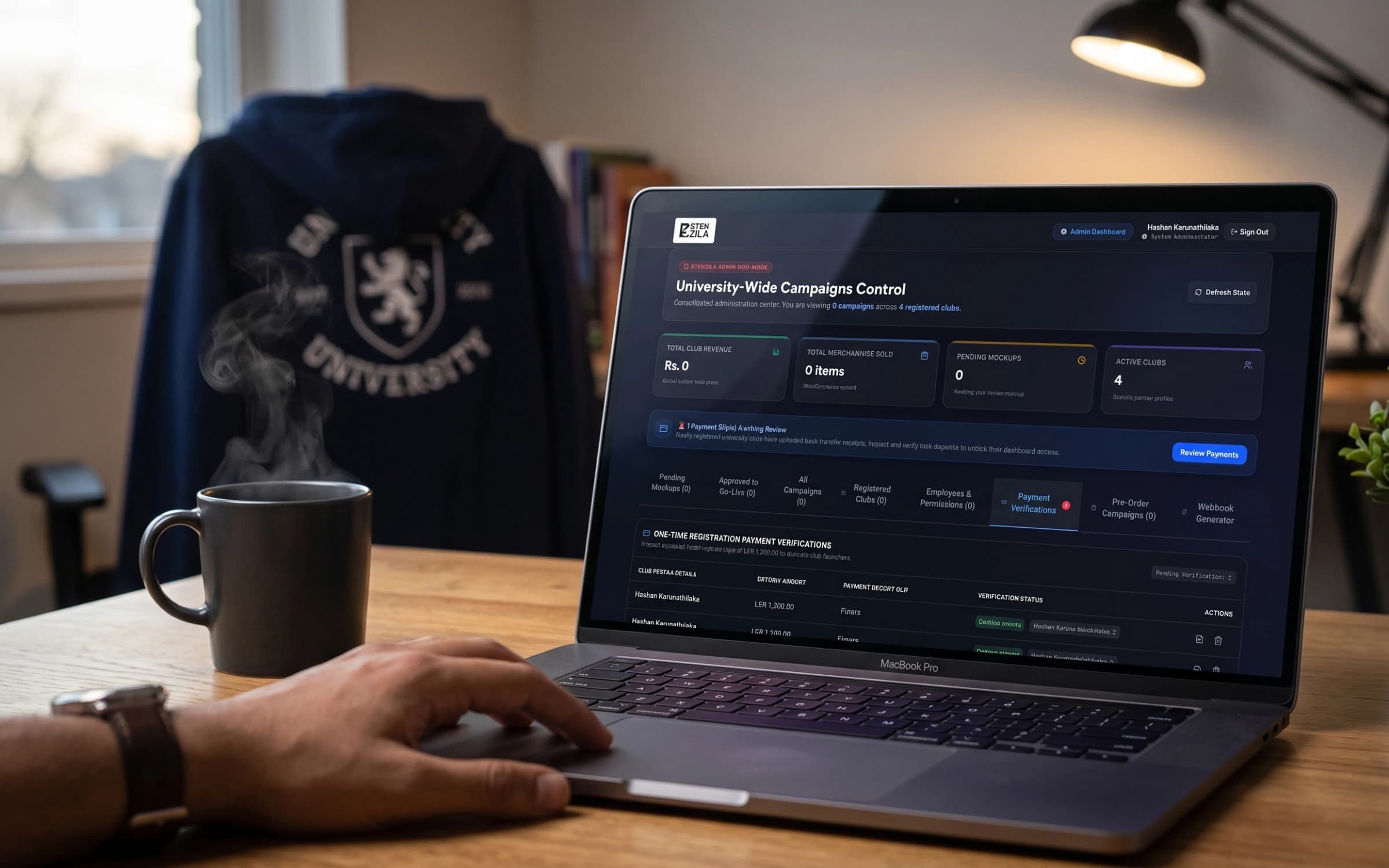
Stenzilais a headless, server-less e-commerce management platform built to automate custom merchandise drops for university clubs and student organizations. It completely replaces fragmented workflows, like Google Forms, manual bank slip verification via WhatsApp, and spreadsheets. With an integrated digital pipeline.Core Capabilities- Role-Based Workspaces: Dedicated dashboards for student club committees to monitor sales, review design mockups, and track revenue, paired with a central administrative command center for fulfillment. - Headless Checkout Drop-Zones: Fast, standalone landing pages featuring dynamic campaign pricing, size selection, and direct bank deposit receipt uploads. - Automated Webhook Ingestion: Real-time order processing that instantly routes customer details and payment slips directly to cloud storage and administrative review. - Enterprise Google Authentication: Single-sign-on (SSO) integration ensuring verified, secure access without the risk of fake accounts or forgotten passwords.
In short:
Stenzila turns complex, high-friction student merchandise logistics into a streamlined, automated, zero-upfront-cost digital store.
Challenge
1.The Logistical Nightmare of Student Merch
University clubs and student societies in Sri Lanka were facing severe administrative burnout when launching custom merchandise. The existing operational stack was heavily fragmented: clubs were using Google Forms to collect sizing data, forcing students to manually send bank deposit slips via WhatsApp, and tracking the fulfillment process on messy, error-prone spreadsheets.
This disconnected workflow led to a high margin of human error, lost payments, fake orders from burner emails, and massive friction at checkout. Stenzila needed to architect a centralized, highly secure platform that could ingest orders from anywhere, verify university identities, and automate the entire operational pipeline with zero upfront cost to the clubs.
Solution
A Decoupled, Server-less Architecture
To solve this, we engineered Stenzila, a headless, role-based platform bridging client club workspaces with a core administrative command center. The architecture was intentionally decoupled: - The Face (Frontend): A blazing-fast React dashboard hosted independently, utilizing glassmorphism UI for a premium tech feel. - The Brain (Backend): A stateless Node.js / Express API containerized and deployed on Google Cloud Run. - The Drop Zones: External, lightweight HTML checkout forms distributed to clubs, designed to fire POST webhooks directly to the Stenzila engine.
Results
The Impact: By the Numbers
- 100% Elimination of manual payment slip verification and spreadsheet cross-referencing.
- < 5 Second Workspace Provisioning for new university clubs via Google OAuth integration.
- 10MB Secure Payload Capacity achieved for isolated, unauthenticated public webhook drops.
- Zero Back-end Downtime during launch via Google Cloud Run auto-scaling architecture.
Developer Insights: Technical Roadblocks & Triumphs
Building a seamless bridge between anonymous public checkouts and highly secure database environments presented unique technical challenges. Here is how the engineering team solved them:
1. The "Phantom File Server" and the 1MB Crash
The Problem:
During beta testing, the platform crashed with a 400 Bad Request whenever a user attempted to upload a payment slip larger than 1MB.
The Diagnosis:
The application was experiencing a silent architectural fault. Because Firebase Storage rules were inadvertently misconfigured inside the Firestore Database tab, Firebase Storage was completely locked down. However, the React frontend had a robust fallback script: when it was denied access to Storage, it silently converted the image into a Base64 text string and shoved it directly into the Firestore database. When a 3MB image was uploaded, it hit Google Firestore's hard 1MB per-document limit, shattering the illusion.
The Fix:
We completely decoupled the security layers. We implemented a strict 10MB request.resource.size limit in the actual Firebase Storage environment to handle the heavy image blobs, and configured the React app to only pass the lightweight CDN downloadURL strings to the Firestore database.
2. The Client SDK Server Block (HTTP 500)
The Problem:
The headless HTML checkout forms successfully fired data to the Google Cloud Run webhook endpoint, but the server immediately threw a [FirebaseError: 7 PERMISSION_DENIED] and crashed.
The Diagnosis:
The Node.js backend was initialized using the Firebase Client SDK. Because the backend wasn't "logged in" with a user account, the strict Firestore database rules treated the Cloud Run server like an anonymous public user and bounced the write request.
The Fix:
Instead of re-architecting the backend to use the heavy Admin SDK, we implemented surgical "Server Bypass" rules in Firestore. By isolating background collections (match /webhook_logs/{logId} { allow create: if true; }), we essentially built a secure, one-way "Drop Box" that allowed the server to ingest data freely while keeping all club data strictly locked behind authentication.
3. The Enterprise Auth Pivot
The Problem:
Relying on custom SMTP infrastructure (sending One-Time Passcodes via email) left the platform vulnerable to brute-force attacks and spam registrations from temporary email addresses.
The Fix:
We executed a hard pivot, entirely stripping out email/password authentication in favor of strictly enforced Google Workspace OAuth. This shifted the entire security burden onto Google's infrastructure, ensuring that only users with verified university or official Gmail accounts could access the Stenzila dashboard, resulting in zero fake accounts and instant onboarding.
Technologies & Tools
Welby Design's engineering of my idea into a live digital platform eliminated the hassle of merchandising for social clubs and universities as well as generated a great marginal income of 20% from each merchandising launch . Thanks to Welby Design's easy-to-use UI we are running the application smoothly and effortlessly. Great services and would recommend 100%
Danujaya Rathnayaka, Founder Stenzila PVT(LTD)
Project Details
2026
3 Months
$under – $5K
2 people