Alcast Online: Selling Custom Aluminium Windows Online Without Losing the Dealer
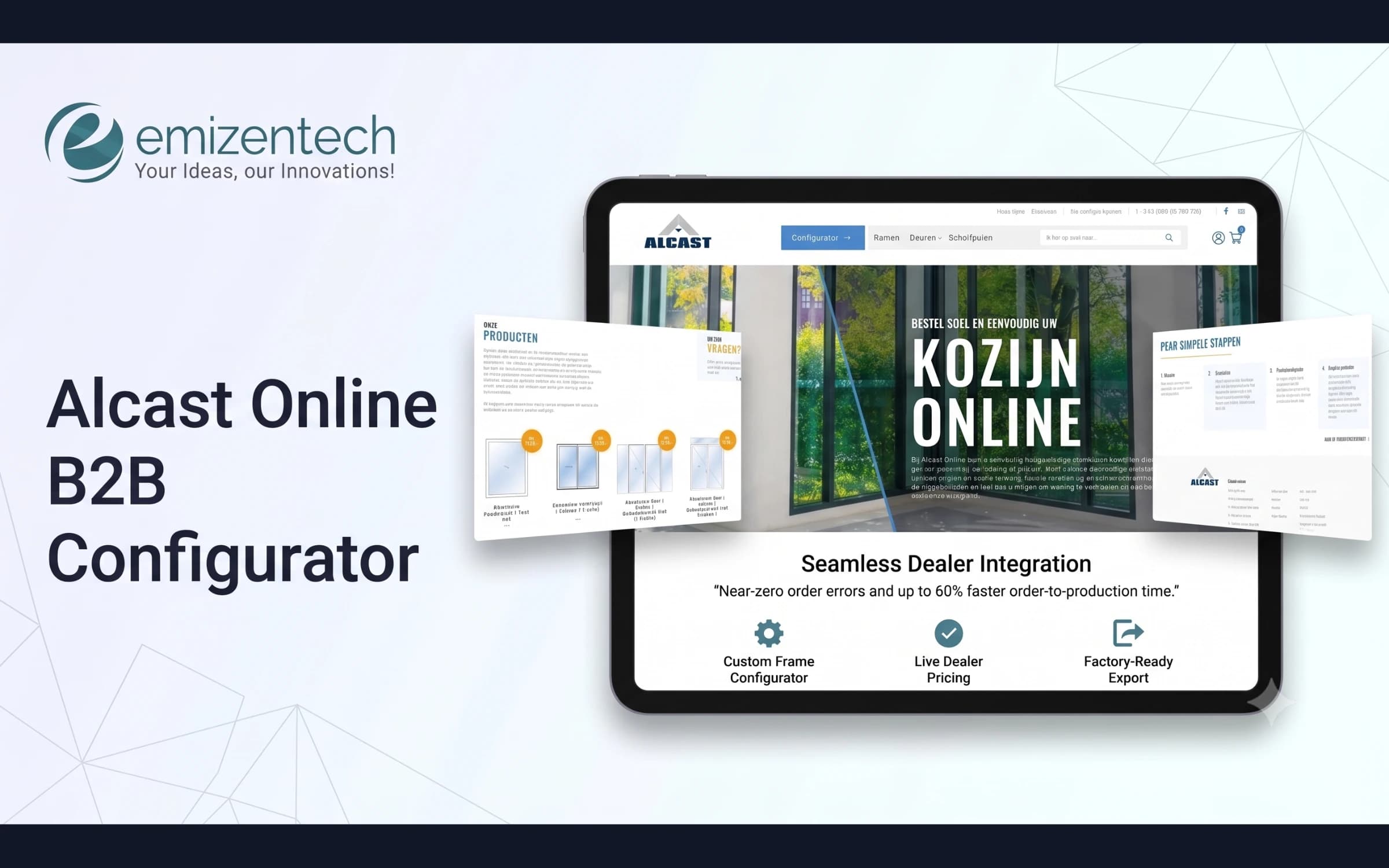
Alcast manufactures aluminium windows, doors, sliding systems, folding walls and facade systems out of Leunen in the Netherlands. They are a Reynaers Aluminium dealer with years of reputation behind custom, made-to-measure frames. Almost all of that business ran on phone calls, emails and in-person visits.
Every order arrived as a call or an email that someone in production planning had to decipher and re-key into the factory system. Mistakes happened. Orders sat in an inbox for hours. During renovation season it was chaos.
- What we built: Alcast Online, a dealer-facing configurator and ordering portal on WordPress. Installers log in, configure profile system, dimensions, glass spec, colour, hardware and add-ons through a stepped flow, see live pricing at their own contract tier, save drafts, and place orders that land in the factory planning system as structured JSON — no re-keying.
Results six months after rollout: roughly 85% of dealer orders now flow through the portal, order-intake errors down 92%, average order-to-production time down 60% (from about eight hours to three), dealer satisfaction up 34% on an internal survey, and 15 new dealer sign-ups in the first 90 days from the public catalog pages.
- How we worked: Alcast engaged our wordpress developers to write the configurator logic, the pricing rules and the factory export layer from scratch. No off-the-shelf plugin was going to handle the Reynaers profile rules matrix.
Because the portal holds dealer contract tiers, volume discount logic and a live bridge into the factory planning system — commercially sensitive data belonging to a Netherlands-based business subject to GDPR — the engagement ran inside Emizentech's ISO 27001:2022 information security and ISO 9001:2015 quality management systems, both independently audited rather than self-declared.
Challenge
The old setup worked. It just did not scale, and there were five layers to untangle before anything sensible could be built.
Configuration complexity. Aluminium frames are not a fixed SKU. Every order combines profile system, dimensions, glass spec, colour, hardware, ventilation and finish. The site had to hold all of that without turning into a CAD program that no dealer would open twice.
Dealer-only pricing. Pricing depends on dealer tier, project volume and ongoing contracts. That logic could not be exposed publicly, and it could not be hard-coded either — it changes.
Factory integration. Orders had to reach production planning with enough structured data that nobody re-entered them by hand. Anything less and the portal just relocates the transcription step rather than removing it.
Trust on a B2B site. Installers are conservative buyers. The portal had to feel solid and predictable rather than trendy. A configurator that looks like a startup landing page loses this audience.
Non-digital-native users. Many dealers are skilled craftsmen, not power users of web applications. The interface had to stay simple while doing heavy lifting underneath — which is a harder engineering problem than the reverse.
Solution
- A week on the factory floor before any design work. We ran on-site interviews at Leunen, sat in on order intake calls, and watched how the planning team actually worked. The finding that shaped everything: dealers did not want a fancy 3D configurator. They wanted a fast, predictable form where they could drop in measurements, pick the options they already knew by name, and be done. That is the kind of insight you only get by going there, and it saved the project from building the impressive thing instead of the useful one.
- A stepped configurator, not a single-page app. Product type → dimensions in millimetres → profile series → glass spec (standard, HR++, acoustic, safety) → colour by RAL code → hardware set → add-ons → review. Each step is savable, so a rep can pause mid-quote and return without losing work. Pricing updates live against that dealer's own tier as options are chosen.
- Custom plugin, because the rules matrix demanded it. We hand-wrote a PHP plugin for the product rules, pricing engine and order state, with a lightweight Vue.js front end embedded inside it. No off-the-shelf configurator handles the Reynaers profile logic, and forcing one to would have meant fighting the plugin for the life of the product. This is the line where CMS development stops and custom software development begins — WordPress handles content and authentication, and the business logic lives in code you own.
- A dealer role model extending WordPress's own user system, with separate permissions for dealer-owner, dealer-staff and factory support. Building on WP's user layer rather than beside it kept authentication in one place.
- Structured export into the factory. A scheduled job pushes finalised orders into the production planning system over a secure REST bridge as structured JSON — panel dimensions, glass codes, hardware BOM, all of it. Production planning stopped interpreting handwritten sheets. Error rates on intake dropped close to zero within the first month. Getting the payload shape right is the whole job here; connecting a web front end to ERP and production systems fails when the export is an afterthought rather than a designed interface.
- A public funnel alongside the private portal. On alcastonline.nl's open pages we built a lightweight product catalog with SEO-friendly pages for each profile system and typical use case, plus a Gravity Forms application flow for new dealers. That gave Alcast an acquisition channel rather than only an account-servicing tool — and it produced 15 sign-ups in 90 days.
- Dutch and English via WPML, for cross-border dealers.
- Security as a B2B baseline. TLS, WAF and 2FA on admin logins, with dealer pricing tiers and contract terms treated as the commercially sensitive data they are. The engagement sat inside our ISO 27001:2022 controls covering access management, encryption and vendor review, and the release gates, code review and defect handling followed the documented process set by our ISO 9001:2015 certification. For a Netherlands-based client under GDPR, having that framework already in place shortens the procurement conversation considerably.
Results
- Measured six months after the full portal rolled out to the dealer network.
- 85% online order adoption. Share of dealer orders flowing through the portal rather than phone or email. On a dealer base that included plenty of people who had never used a web application for work, that is the number that matters most a portal nobody adopts is a rounding error.
- −92% order-intake errors. Near-zero mistakes on the factory side once the JSON export went live, and within the first month.
- 60% order-to-production time. Average hours from order placed to production slot booked fell from roughly eight to roughly three.
- +34% dealer satisfaction. Internal survey of the dealer network at six months post-launch.
- 15 new dealer sign-ups in the first 90 days, driven by the public-facing catalog pages an acquisition channel that did not exist before the build.
- Re-keying eliminated. Production planning no longer transcribes orders by hand, which is the mechanism behind both the error reduction and the time saving.
- A calmer factory floor during renovation season, which was the original complaint and is not something a dashboard measures.
Why WordPress Instead of a B2B SaaS Subscription
If your order is more complicated than a shopping cart, the reflex is to go shopping for a B2B commerce platform. Often you do not need one. Alcast's rules matrix — Reynaers profile systems, dimension constraints, glass specs, dealer contract tiers — was never going to fit a configuration screen in someone else's product, so the choice was between fighting a SaaS tool forever or writing the logic once. WordPress handled content, authentication and roles; a hand-written plugin held the business logic. Cheaper, and with far less lock-in. That is the kind of project where it pays to hire WordPress developers who understand business logic rather than themes — the distinction matters enormously here, and most WordPress work on the market is the other kind.
Designing for Users Who Did Not Ask for Software
Many Alcast dealers are craftsmen, not web-app users, and they were doing fine on the phone. A portal has to be faster than the thing it replaces or adoption never happens. Our week of on-site interviews found dealers wanted a fast predictable form, not a 3D configurator — so we built a stepped flow using the option names they already say out loud, with savable drafts and RAL swatches so nobody argues about beige versus cream. The 85% adoption figure is the result of that research, not of the feature list. Any ecommerce project aimed at a non-digital-native audience lives or dies on this.
The Export Is the Product
The visible half of this build is a configurator. The half that produced the 92% error reduction is a JSON payload — panel dimensions, glass codes, hardware BOM — pushed into the factory planning system over a secure REST bridge on a schedule. If that export is vague, the portal simply moves the transcription step from the planning team to somebody else. Designing the payload against the production system's actual requirements, early, is what turns a nice front end into an operational change. The same principle governs any integration between a web layer and ERP and production systems.
Security and Certification on a B2B Portal
This portal holds dealer contract tiers, volume discount logic, order history and a live bridge into a manufacturing planning system — commercially sensitive on both sides. The build shipped with TLS, WAF and 2FA on admin logins as a baseline, plus role separation across dealer-owner, dealer-staff and factory support. Emizentech holds ISO 27001:2022 for information security, covering access control, encryption, vendor review and incident response, and ISO 9001:2015 for quality management, governing release gates, code review and defect handling. Both are independently audited rather than self-declared. For EU clients operating under GDPR, that framework is usually a procurement requirement rather than a differentiator — worth asking any prospective partner for the certificate rather than the claim.
The Team Shape for a Build Like This
Discovery, configurator logic, a pricing engine, a factory integration and a public SEO layer are different skill sets, and splitting them across vendors is where these projects break — usually at the integration seam. Alcast ran it as one engagement. Depending on the shape of a build, that means hire dedicated developers, PHP developers, web developers, full-stack developers or hire ecommerce developers on a single team, or a fractional CTO where the gap is technical direction rather than delivery capacity. Our broader web development and software development services practices cover the rest.