12 Better Alternatives to G2 (G2.com) in 2026
Updated August 2026. This guide was originally published in February 2026 and has been fully revised to reflect the G2–Capterra consolidation and major changes across the software-buying market.
G2 remains one of the largest places to read software reviews, but it is no longer the only useful starting point. No single website replaces every part of the software-buying process.
On January 29, 2026, G2 announced an agreement to acquire Capterra, Software Advice, and GetApp from Gartner. Gartner reported that the sale of its Digital Markets business closed on February 5, 2026, for approximately $110 million before adjustments. G2 says the combined network reaches more than 200 million software buyers annually and contains nearly six million verified reviews.
That is major market consolidation. Capterra, Software Advice, and GetApp may retain their familiar brands, but they are no longer independent alternatives to G2. Buyers who want a genuinely different source now need to look across several categories: curated discovery, verified enterprise reviews, pricing intelligence, direct purchasing, software management, community discussion, and firsthand referrals.
How to choose the right G2 alternative
The best option depends on the question you are trying to answer:
- “What software should we consider, and can we buy and manage it in the same place?” Start with Cubbie.
- “What do verified customers and enterprise technology buyers say?” Use TrustRadius or Gartner Peer Insights.
- “What should we actually pay?” Use Vendr for contract pricing benchmarks and negotiation context.
- “Where can we buy an emerging tool at a discount?” Explore AppSumo.
- “What is new or popular among builders?” Browse Product Hunt or SourceForge.
- “What do real people say outside a software marketplace?” Check Google, Trustpilot, Reddit, LinkedIn, and your professional network.
Below are 12 useful alternatives. Some compete directly with G2, while others address a different and sometimes more important part of the buying journey.
1. Cubbie: Best for discovery, purchasing, and software management in one system
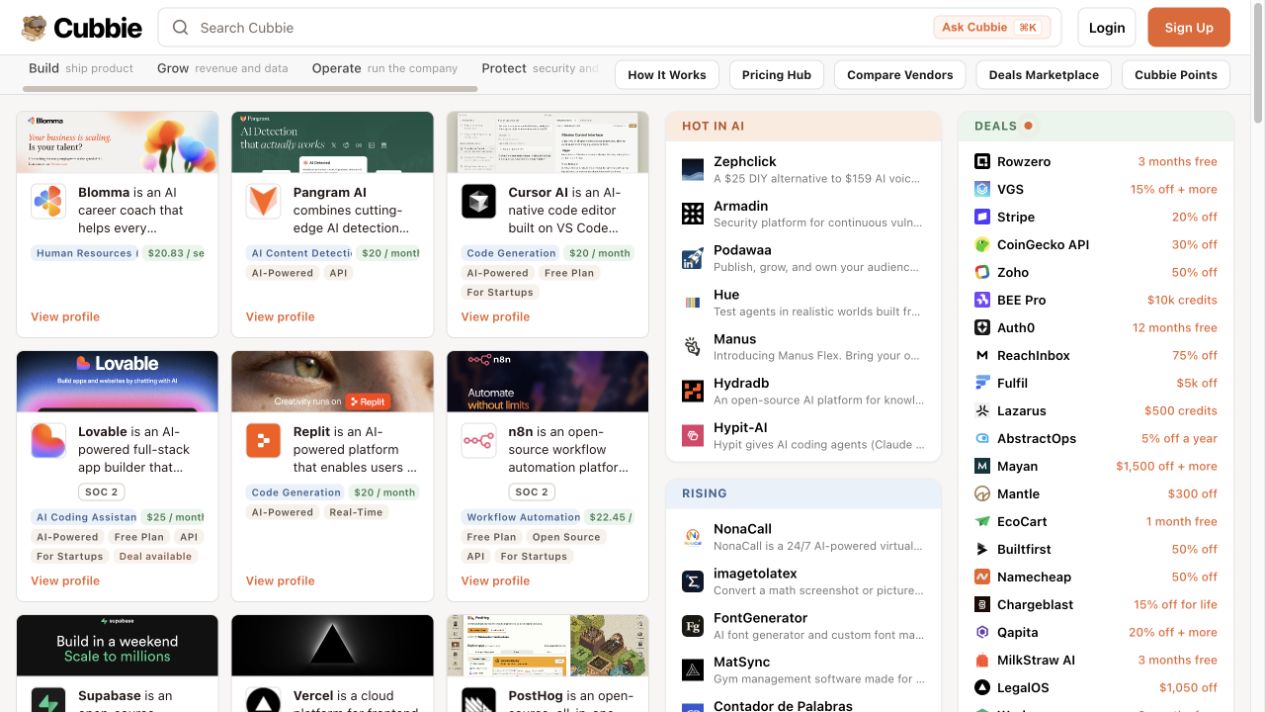
Cubbie has evolved well beyond software discovery. It now covers the software lifecycle: teams can research products, buy software, and manage the resulting stack in one place.
Discovery: Cubbie organizes tens of thousands of products across more than 2,000 categories. Buyers can browse by business outcome, department, industry, and product type; build shortlists; compare tools; and review pricing, integrations, security, best-fit company size, and stack context. Cubbie says its organic results are ranked by relevance and trust signals rather than by who pays for the highest position, while paid placements are labeled.
Buying: Cubbie supports more than affiliate links. Buyers can use direct checkout, redeem verified vendor offers and private pricing, request quotes, run multi-vendor RFPs, join group buys, and route purchases through finance, IT, and security approvals. Cubbie says buyer accounts are free, buyers never pay more than buying direct, and qualifying on-platform purchases earn 1% back in Cubbie Points. See the current Cubbie deals marketplace for live offers.
Management and optimization: Cubbie’s subscription registry tracks each tool’s spend, renewal date, owner, status, source, seats, contracts, and documents. Records can be added manually, imported by CSV, detected through recurring bank and card charges, connected through identity providers and vendor integrations, or created automatically after a Cubbie purchase. Renewal alerts, seat-drift findings, duplicate-vendor detection, contract obligations, and budget approvals help teams reduce waste after the initial decision.
Why it is different from G2: G2’s familiar strength is its enormous crowdsourced review corpus. Cubbie is more useful for a team that wants to move from “Which tool should we consider?” to “How do we approve, purchase, track, renew, and optimize the tools we use?” without stitching together a review site, procurement service, spreadsheet, and SaaS-management platform.
2. TrustRadius: Best for detailed, verified B2B software reviews
TrustRadius is one of the closest direct alternatives to G2. It focuses on in-depth B2B technology reviews, product comparisons, and buyer intent. Reviews commonly include use cases, pros and cons, implementation context, and company details that make them more useful than a simple star rating.
TrustRadius is especially useful when you already have a shortlist and want to understand how a product performs for companies like yours. It was acquired by HG Insights in June 2025, but it remains a distinct review destination. The acquisition price was not publicly disclosed, so older estimates should not be treated as fact.
Best fit: Mid-market and enterprise buyers comparing established B2B software. Limitation: Coverage can be thinner for very new or highly specialized products.
3. Gartner Peer Insights: Best for verified enterprise technology reviews
Gartner Peer Insights remains separate from the Capterra, Software Advice, and GetApp businesses Gartner sold to G2. It concentrates on enterprise technology and reviews written by verified end-user professionals.
Gartner says reviewers go through corporate-email, employer, role, and conflict-of-interest checks, and reviews are moderated for quality and context. That makes Peer Insights useful for enterprise IT leaders evaluating established vendors in security, infrastructure, data, communications, and other complex categories.
Best fit: Enterprise technology buying committees that value reviewer identity and organizational context. Limitation: It is less useful for emerging startup tools, creator software, and small-business apps, and some detail requires an account.
4. Vendr: Best for real-world SaaS pricing and negotiation
Vendr, now part of Vertice, is not primarily a software-review directory. It becomes valuable after a buyer has moved from “What products exist?” to “What should we actually pay?”
Vendr provides anonymized pricing benchmarks from real software contracts, side-by-side price context, supplier-specific negotiation insights, and help navigating purchases and renewals. Its Software Prices experience says it covers more than 20,000 products and uses more than $5 billion in contract data.
Best fit: Finance, procurement, and IT teams negotiating SaaS contracts or validating a quote. Limitation: Pricing intelligence cannot replace product testing, security review, customer references, or a careful assessment of whether the software solves the right problem.
5. AppSumo: Best for buying discounted emerging software
AppSumo is closer to a software storefront than a traditional review site. It specializes in limited-time offers from emerging software companies, frequently including lifetime access for a one-time payment. That makes it attractive to entrepreneurs and small teams that want to test new tools without immediately adding another monthly subscription.
AppSumo advertises discounts of up to 95% and a 60-day money-back guarantee. The marketplace also has buyer reviews and questions that can reveal how a product performs while it is still developing.
Best fit: Startups, creators, and small businesses willing to try early-stage products in exchange for aggressive pricing. Limitation: “Lifetime” refers to the lifetime of the product, not the buyer. Early-stage tools can change direction, be acquired, or shut down. Test the product during the refund window and do not make a mission-critical workflow depend on a deal alone.
6. Product Hunt: Best for discovering newly launched products
Product Hunt is a daily discovery community where founders launch products and users vote, comment, and ask questions. It is particularly useful for seeing new AI tools, developer products, productivity apps, and startup software before those products accumulate enough reviews to rank prominently elsewhere.
Product Hunt became independent from AngelList in 2021, with AngelList remaining an investor. It continues to operate as a daily, community-ranked product discovery platform.
Best fit: Early adopters and buyers who want to find what is new. Limitation: Launch-day enthusiasm is not the same as long-term customer evidence. Use Product Hunt to build a shortlist, then validate pricing, support, security, and retention elsewhere.
7. SourceForge: Best for open-source and business software discovery
SourceForge combines a large open-source software repository with business-software listings, comparisons, reviews, and product categories. It is useful when open-source availability, hosting model, or technical community adoption matters to the decision.
Best fit: Technical buyers comparing open-source projects and established business applications. Limitation: The experience spans downloads, project hosting, reviews, and vendor listings, so the signal can feel less uniform than a tightly moderated enterprise-review platform.
8. Google Reviews and Search: Best for validating company reputation
Google Business Profiles are not a replacement for feature-by-feature software comparisons. However, Google is often where buyers validate whether a company is real, responsive, and well regarded. This is especially useful when software is paired with implementation, consulting, support, training, or a local office.
Search also surfaces documentation, security pages, customer stories, implementation partners, community discussions, job postings, incident histories, and independent commentary. Those sources can reveal more than a review score alone.
Best fit: Reputation checks and service-heavy vendors. Limitation: Many pure SaaS companies do not have meaningful Google review coverage, and a business-location rating is not a product evaluation.
9. Trustpilot: Best for broad customer-experience signals
Trustpilot collects consumer and business reviews across many industries. For software buyers, it can be useful for spotting recurring themes around billing, cancellation, customer support, refunds, onboarding, and account access.
Best fit: Understanding the customer-service experience around a widely used product. Limitation: Broad reputation reviews rarely contain the technical, role-specific, or implementation detail needed for a serious software selection.
10. Reddit: Best for candid peer discussion and troubleshooting
Reddit can surface blunt, highly specific conversations about migrations, contract surprises, support quality, implementation failures, and which alternatives users chose after leaving a product. Niche communities often discuss details that never appear in polished case studies.
Best fit: Learning what questions to ask and finding real-world edge cases. Limitation: Reddit identities are often anonymous, experiences are hard to verify, and loud opinions can distort the picture. Treat individual posts as leads for further research, not as conclusive evidence.
11. LinkedIn: Best for evaluating the people behind a product
LinkedIn helps buyers investigate a vendor’s leadership, product team, customer community, implementation partners, and employee history. Search a product name alongside terms such as “migration,” “implementation,” “renewal,” “security,” or “customer” to find posts from practitioners who have used it.
Best fit: Understanding who is building and supporting the software, and asking identifiable peers for context. Limitation: LinkedIn rewards personal branding and positive announcements, so it is less likely to contain the full range of customer experiences.
12. Word of Mouth: Best for trusted, context-rich referrals
A recommendation from a peer who knows your company, constraints, team, and existing stack can be more useful than hundreds of anonymous reviews. Ask what the person bought, what alternatives they rejected, how long implementation took, what the vendor did poorly, whether the price changed at renewal, and whether they would buy it again.
Best fit: High-stakes decisions where trust and implementation context matter. Limitation: One company’s perfect tool can be another company’s mismatch. A referral should improve your shortlist, not replace due diligence.
Which G2 alternative should you use?
- Choose Cubbie when you want software discovery, purchasing, approvals, subscription tracking, and renewal optimization in one platform.
- Choose TrustRadius when detailed B2B reviews and use-case context matter most.
- Choose Gartner Peer Insights for verified enterprise technology reviews.
- Choose Vendr when pricing benchmarks and negotiation are the main problem.
- Choose AppSumo when you want to buy an emerging tool at a steep discount and can tolerate early-stage risk.
- Choose Product Hunt or SourceForge to expand your discovery set, especially for new or open-source products.
- Use Google, Trustpilot, Reddit, and LinkedIn together to validate reputation and uncover experiences outside vendor-controlled channels.
- Use trusted referrals to add context that no public directory can fully capture.
Final thoughts
The software market no longer fits neatly into a list of review websites. Reviews are useful, but buyers also need accurate product data, transparent pricing, purchasing workflows, contract evidence, renewal visibility, and candid conversations with people they trust.
That is why the strongest alternative to G2 may be a combination: Cubbie for discovery, buying, and ongoing stack management; TrustRadius or Gartner Peer Insights for verified review depth; Vendr for contract pricing; AppSumo or Product Hunt for emerging products; and independent peer research for the final reality check.