What Happens to Developers in the Claude Code Era?
Will AI replace software developers?
No. It replaces a large share of the typing, not the thinking. The clearest signal comes from inside the tools themselves. Boris Cherny, the creator of Claude Code, has said that the title software engineer will start to go away, and that everyone is going to be a product manager, and everyone codes. That is not a layoff prediction, it is a job-description change. His point is that the human keeps the intent and the judgment while the machine handles the mechanical part.
What is an orchestra developer?
An orchestra developer is a single point of ownership for a feature. Instead of a developer sitting in a team next to a separate product manager, a designer, and an analyst, one person carries the feature the whole way: they talk to the client, design it, build the frontend and the backend, stand up the infrastructure, and deploy it. They do not do all of this by hand. They amplify themselves with AI agents, the way a one-person band plays every instrument at once.
How does an orchestra developer work day to day?
The day does not look like heads-down typing. It looks like a conductor moving between sections. A single feature tends to run like this:
-**Talk to the client.**The owner takes the goal directly, not a pre-chewed ticket. Because they will build it, they ask the questions that actually matter for implementation.
- **Shape the design.**They sketch the user flow and the data model, then have an agent turn that into a first interface and schema to react to.
- **Run agents in parallel.**One agent drafts the frontend, another the backend, a third writes tests. The owner reviews each like a pull request, rejecting what is wrong and steering the next pass. -**Stand up the infrastructure.**Infrastructure as code, a deploy pipeline, and the cloud resources go up through the same agent-and-review loop, with the owner making the calls on anything sensitive.
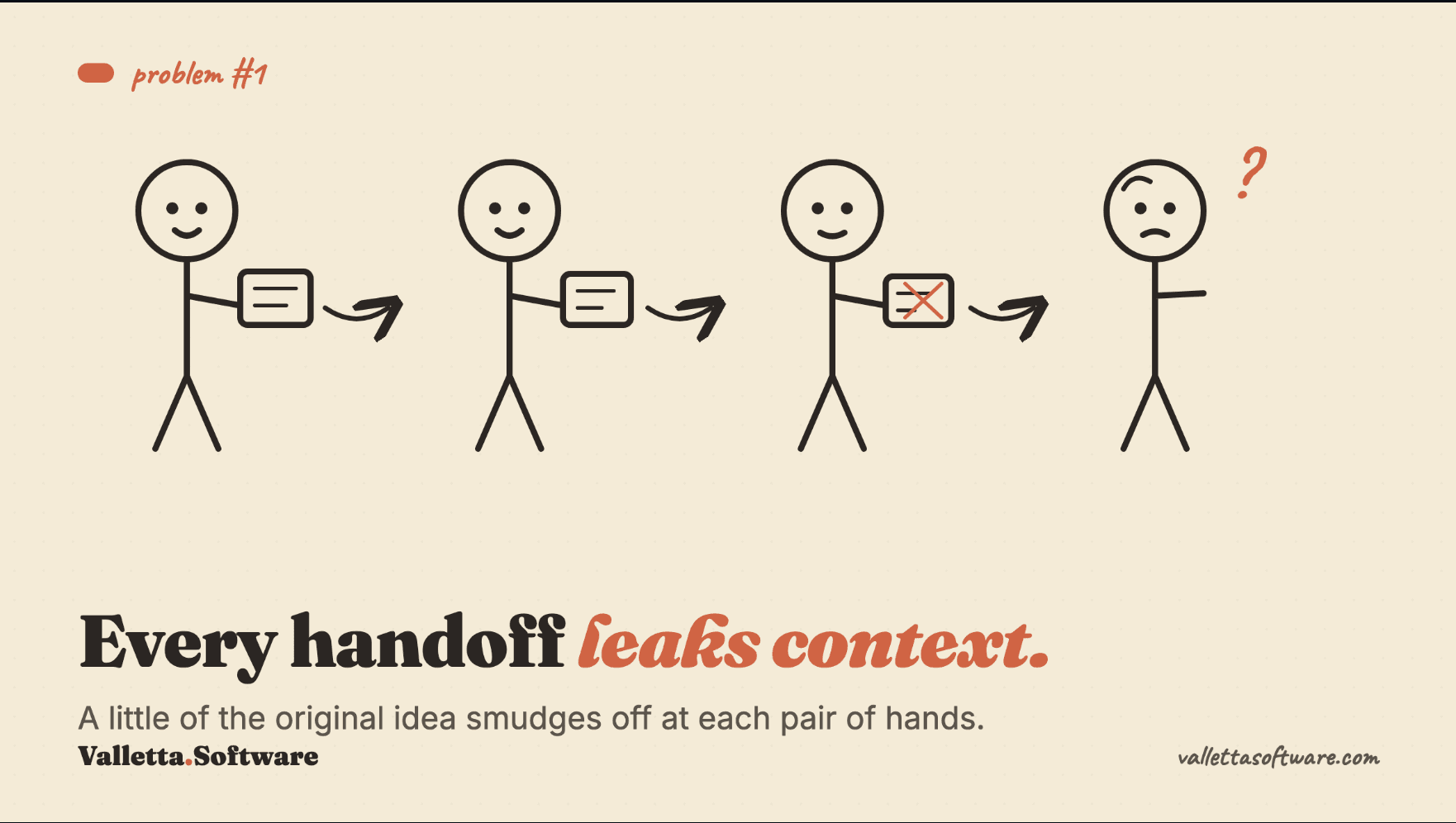
- **Ship and own it.**They deploy, watch it in production, and fix what breaks. There is no handoff to an ops team that has never seen the feature.**Why do handoffs slow software teams down?**Because every handoff leaks context. When a designer, an analyst, and a product owner each pass a feature to the next pair of hands, a little of the original idea smudges off at each step. By the time it reaches implementation, what gets built is a faint copy of what was first imagined. It is the office version of the telephone game, and it is the single largest source of friction in normal team delivery.
What changes for junior developers?
This is the hardest part of the transition, and it deserves honesty. The traditional on-ramp, where a junior developer learns by writing many small, low-risk functions, is exactly the work agents now absorb. If the entry-level tasks disappear, the path to senior judgment gets steeper.
The way through is to push juniors up the same ladder the role itself is climbing. Instead of measuring them on lines written, give them small features to own end to end, with a senior reviewing the critical paths. Have them read and critique AI output early, so they build the taste to spot when it is wrong. The skill to develop is not raw coding speed, which is now cheap, but the judgment to direct and verify, which is now scarce. A junior who learns to own outcomes and review agents will compound faster than one who only learns to type code an agent could have written.
What does this mean for engineering teams and hiring?
If you lead an engineering team, the practical move is not to fire half of it and hope agents fill the gap. It is to restructure around ownership. Fewer, stronger people, each owning features end to end, supported by agents and held to a hard review discipline on the parts that matter. You trade a large group that coordinates a lot for a small group that ships a lot.
Key takeaways
- AI does not delete the developer role, it raises its altitude: from typing code to owning features and directing agents.
- The biggest win is fewer handoffs. Every handoff between roles leaks context, and one owner end to end keeps that context intact.
- The result is faster delivery, a single point of accountability, and lower coordination cost.
- The honest catch: AI often reports code as secure when it is not, so critical paths still need an independent human review.
- The skill that pays shifts from writing code to taste, judgment, and review.