Zero Staff, Nationwide: A Smart Lock SaaS Platform Shipped in 8 Weeks
Modal Pods puts modular prefabricated buildings at EV charging sites. The reasoning is hard to argue with: a charging session runs 30 to 60 minutes, and most sites give you a parking space and nothing else. A clean, private, climate-controlled room is worth something at minute twelve of a charge.
The building was never the hard part. Everything that happens the second somebody walks up to one - that was the hard part.
Modal wanted no staff on site. Not minimal staff. None. So the door has to let the right person in, take their money, expire their access, log the whole thing, and do it at every pod in the country without anyone touching a keyboard.
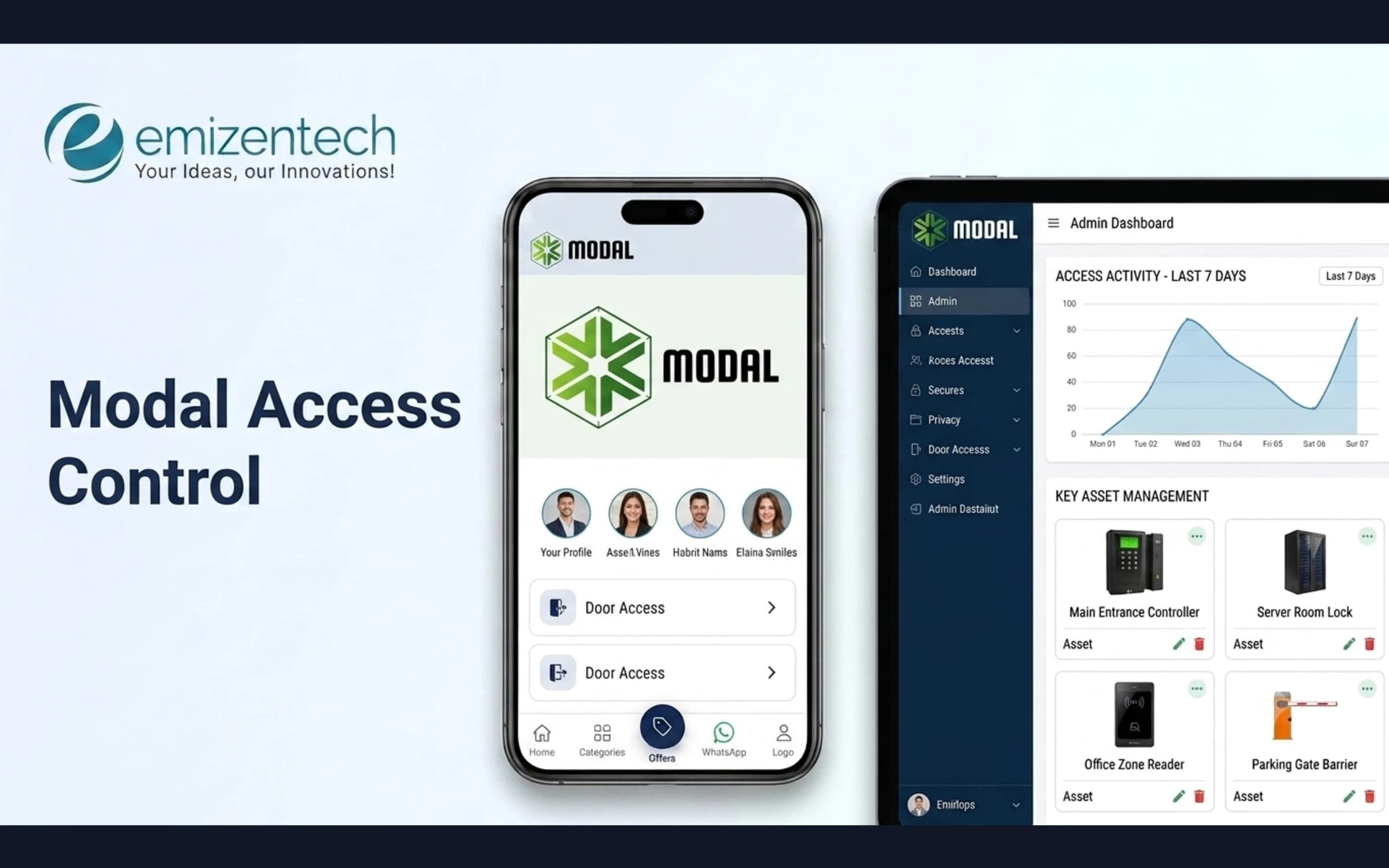
What we built in eight weeks: a QR-entry progressive web app with no install step, a NestJS backend with an Access Engine that runs the credential lifecycle unattended, and a super admin dashboard that runs the entire business — sites, pods, subscribers, refunds, maintenance codes, audit logs and revenue analytics.
-How we built it: Modal chose to hire dedicated developers as a seven-person squad rather than sign a fixed-scope contract project manager, designer, two Node.js developers on the backend, two React developers across the PWA and admin dashboard, plus QA and DevOps. Four two-week sprints, kickoff to production.
Because the platform handles subscriber data, payment references and the access records that resolve every future security or billing dispute, the build ran inside Emizentech's ISO 27001:2022 information security and ISO 9001:2015 quality management systems independently audited certifications, not self-declared claims.
Live at go.modalpods.com.
Challenge
Four problems shaped every decision that came after them.
- Nobody is downloading an app to use a restroom. This was the constraint everything else bent around. A traveller stops to charge, needs the pod, and has maybe two minutes of patience. App store, download, account, password, email confirmation — that funnel loses almost everyone. If entry wasn't near-instant from a cold start, the pods would not get used at all.
- Picking a lock brand shouldn't lock the whole company in. Modal started with Yale keypad locks, a reasonable choice. But hardware decisions age badly, and writing a backend directly against one manufacturer's API turns every future brand change into a rewrite. That is a poor trade for a company planning to scale nationwide.
- One subscription, every pod — but not every site charges. The commercial idea was a network: subscribe once, open any pod at any site in the country. Good product thinking, awkward to model. Some sites are promotional and free while others are paid, and individual pods need to go into maintenance without dragging their whole site down with them.
- No staff means the audit trail has to be perfect. When there is nobody on site, the logs are the operation. Who got in, when, on what credential, and whether it succeeded or failed. Payment disputes, security questions and compliance reporting all resolve against those records, so they had to be complete and impossible to quietly edit after the fact.
Solution
Modal built a web-app access platform for smart pods, designed backward from the physical door lock to minimize friction. The project shipped in eight weeks using four two-week sprints and a dedicated seven-person engineering team.
Key Features & Architecture:
- Instant App-Free Access: Users scan a pod’s QR code to launch a PWA (no app store download required). Cold-start registration/payment to door entry takes under two minutes.
- Offline Keypad Entry: Upon payment/auth, the system issues a 30-minute PIN via screen and Twilio SMS. Entry uses the physical keypad, ensuring access even without cellular signal.
- Automated Access Engine: Webhooks from Stripe trigger Seam API calls to generate lock credentials. Expirations are auto-swept every minute via node-cron.
- Hardware Abstraction: Integrates with smart locks via Seam API, decoupling business logic from specific lock hardware (e.g., Yale, August, Schlage).
- Hierarchical Policy: Configuration (pricing, access rules) is set at the site level and flows down to individual pods.
- Super Admin & Support Tools: Features real-time pod/site management, analytics (peak times, inactive pods), a zero-staff support report queue, and an editable legal CMS.
- Security & Compliance: Database-enforced immutable audit logs (ISO 27001:2022 compliant), 4-role RBAC, token rotation, and tokenized Stripe payments.
- Quality Assurance: ISO 9001:2015 processes, 100% Jest/Supertest coverage on critical paths, and CI/CD automated gates.
Results
- 8-Week Delivery: Delivered from kickoff to production launch via four 2-week agile sprints with a dedicated 7-person squad. Handled integrations across three third-party systems (payments, smart locks, SMS).
- 0 On-Site Staff: Fully autonomous remote pod operation, fulfilling the primary commercial requirement.
- <2 Minute Onboarding: Frictionless scan-to-unlock speed for first-time users with no app installation required.
- ~95% Task Automation: Access Engine and Stripe webhooks fully handle credential lifecycle, delivery, expiry, revocation, and billing without manual intervention.
- Security, Testing & Reliability
- 100% Critical Path Coverage: Comprehensive Jest/Supertest coverage across Auth, Payments, and the Access Engine.
- Zero Critical Launch Vulnerabilities: Validated against OWASP Top 10 standards with completely tokenized payment processing.
- 99.9% Uptime Target: Supported by Sentry, 24/7 monitoring, and two months of post-launch hypercare.
- Scalable Architecture: Designed from Sprint 1 to support future native iOS/Android apps, sensor data, predictive analytics, and white-labeling without requiring architectural rework.
Why a Dedicated Squad Beat a Fixed-Scope Contract
Eight weeks with three third-party integrations is exactly the shape of project where fixed scope hurts most: the unknowns are in the integration seams, and you don't find them until sprint two. Modal chose to hire dedicated developers as a full seven-person squad — PM, designer, two backend, two frontend, QA, DevOps — so that when the schema met reality, the people who wrote it were still there to change it. The honest test for anyone weighing this up: if your requirements are genuinely knowable up front, take a fixed quote from someone. If the risk sits in integrations, hardware behaviour or a model nobody has built before, capacity beats scope. Teams that hire CRM developers or full-stack developers on the same basis are buying the same thing: continuity through the parts of a build nobody could specify in advance.
Abstracting the Hardware Layer
Modal launched on Yale keypad locks. The platform has never spoken to Yale. Everything routes through Seam, a universal smart lock API that also covers August, Schlage and others, so a brand switch becomes device registration rather than backend work. The abstraction cost a few days in sprint one. Skipping it would have cost a rewrite the first time procurement found a better lock. Any on-demand access platform built on physical hardware faces the same choice, and the device layer always changes faster than the business logic does.
This Is a Customer System, Not a Hardware Project
Strip out the locks and what remains is a subscriber database, a billing engine, a support queue, a permissions model and a set of retention reports. The dashboard tracks who subscribed, what they pay, whether payment failed, which pods they used, what they complained about and whether they are likely to churn. Those are CRM questions. The difference from a standard CRM is the core object: most platforms model a contact and a deal, while Modal's world is a pod, at a site, under a policy, with credentials and an access history hanging off it. No off-the-shelf tool holds that shape without a fight — which is precisely when clients come to a CRM development company rather than a platform reseller.
Security, Compliance and Certification
This platform holds subscriber records, tokenized payment methods, invoice references and the access log that resolves every future billing or security dispute. Emizentech holds ISO 27001:2022 for information security — access control, encryption, vendor review and incident response — and ISO 9001:2015 for quality management, governing release gates, code review and defect handling on every project. Both are independently audited rather than self-declared. On this build they showed up concretely: immutable audit records enforced at the database layer, signature-verified webhooks, no raw card data on the server, OWASP Top 10 review before launch. If a build touches payment data or personally identifiable information, ask any prospective partner for the certificate rather than the claim.
Roadmap Left Open on Purpose
Native iOS and Android apps alongside the PWA for repeat users who would rather have an icon than a bookmark — the point at which Modal may hire mobile app developers to extend the same platform. Guest access codes for one-off visitors. Environmental sensors feeding the platform the locks already talk to. Predictive occupancy and revenue analytics. Multi-currency for international sites, a white-label build for partner operators, and CRM integration once the sales pipeline outgrows the admin dashboard. Because the subscriber and usage data model was built properly first, that integration is a mapping exercise rather than an archaeology project.
Technologies & Tools
Project Details
2026
8 weeks
$100K – $250K
7 people