From Radio Calls to Audit-Ready Data: Kia Georgia's Paint Shop App
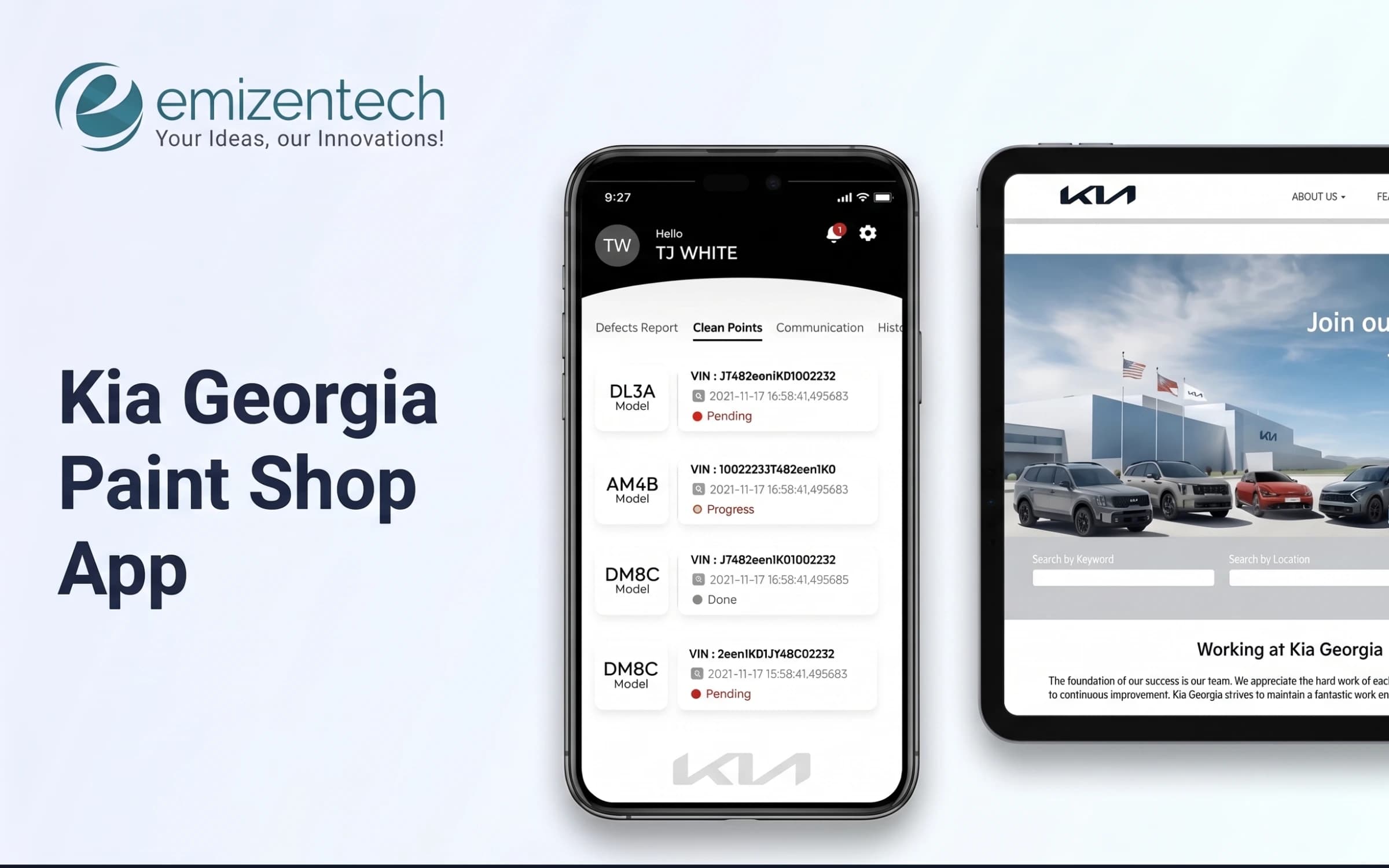
Kia Georgia's paint shop is one of the most demanding stages of the assembly line at the West Point facility — where aesthetic perfection meets industrial durability, and a small oversight in quality control ripples through the entire production schedule. Before the app, tracking a defect or verifying a process update meant navigating internal radio calls and physical logs. Information decayed on the way to whoever needed it.
- What We Built: a cross-platform Flutter app backed by a Laravel API that acts as a single source of truth for paint shop quality assurance — instant defect logging and visualisation, role-based permission layers, immediate alerts for production hurdles, granular tracking of units moving in, through and out of the shop, and digital documentation replacing manual entry. Full feature parity on iOS and Android, because the floor runs on both.
- How We Worked: Kia Georgia chose to hire mobile app developers from us rather than route this through a general IT vendor, and the engagement has continued past launch into ongoing maintenance and iterative refinement based on feedback from specialists on the floor. Three named senior engineers led it: Amit Samsukha (21+ years, enterprise solution architecture), Ajit Jain (12 years, application architecture and cross-platform engineering), and Naren Bhati (8+ years, core development across mobile and backend).
Because the app holds production quality records that are used for auditing, the build ran inside Emizentech's ISO 27001:2022 information security and ISO 9001:2015 quality management systems — independently audited certifications rather than self-declared claims. On a project whose entire purpose is traceable, tamper-resistant records, that distinction is the point rather than a footnote.
Challenge
Information decay is the enemy of a manufacturing plant.
Before the app, tracing a specific defect or confirming a process update meant working through a maze of internal radio calls and physical logs. By the time a report reached the person who could act on it, the line had moved on.
Four constraints shaped the build:
High-frequency data from a 24/7 cycle, without becoming a distraction. A paint shop runs continuously. The app had to absorb a constant stream of quality events and surface only what a given person needed to see. An app that pings everyone about everything gets ignored inside a week, and an ignored app on a factory floor is worse than no app — it creates a false record of oversight.
Critical reports had to reach the right leaders instantly, with the noise filtered out. That meant modelling the plant's actual reporting hierarchy in software: team leads, specialists and managers each seeing a different slice, with permissions matching the real-world structure rather than a generic admin/user split.
Once a quality check was confirmed, the data had to be immutable, traceable and audit-ready. This is a records system before it is an app. Anything that lets history be quietly edited defeats the purpose.
It had to work identically on iOS and Android, in paint shop conditions. Mixed devices across the floor, gloves, poor lighting, no patience for deep menus. Feature parity was a requirement, not a nice-to-have — a team lead on Android and a specialist on iPhone cannot be looking at different products.
Solution
- Floor-level discovery before a line of code. We analysed the specific movements within the paint shop to find exactly where communication broke down and where data was lost. Not a requirements workshop in a meeting room — the failure points were on the floor, and that is where we went to find them.
- Logic mapping to the real hierarchy. We mapped the plant's reporting structure and built the permission model to match it, so the app reflected how the shop actually escalates a problem rather than imposing a generic structure on it.
- UX designed for the factory floor. High-contrast, high-speed, shallow. Specialists in a paint shop do not have time to navigate menus, so we prioritised instant feedback and put the most frequent actions one tap from open. This is where mobile app development services for industrial environments diverges hardest from consumer work — every convention that assumes an unhurried user in good light has to be re-examined.
- One codebase, two platforms. Flutter app development services gave consistent UI behaviour and identical feature sets across Apple and Android devices, with faster iteration cycles than maintaining two native builds — which matters when the refinement loop with floor specialists is ongoing rather than a one-time handover. The mobile layer used Flutter with Cupertino widgets, targeting Android 16 alongside iOS.
- A backend built for traceable records. Laravel handles secure data processing, structured workflows and API communication on an MVC architecture, with MySQL and Eloquent ORM behind it for fast query execution and traceable records suited to audit-ready documentation. JWT authentication and SSL throughout. Standard software development services engineering, applied to a domain where the record's integrity is the product.
- Stress testing against peak production. We simulated high-volume reporting scenarios to confirm the notification engine and database could absorb production spikes without failing. An app that works in normal conditions and falls over during the shift that most needs it has solved nothing. That testing sat inside our software testing and QA practice, and the release gates and defect handling behind it follow the documented process set by our ISO 9001:2015 certification.
- Deployment through secure internal channels, with access restricted to authorised Kia personnel — production quality data is commercially sensitive, and the ISO 27001:2022 controls covering access management, encryption and vendor review applied to the whole engagement.
- Iterative refinement, still running. We continue to support and maintain the app, tuning the reporting modules based on feedback from specialists on the floor. Enterprise teams hire dedicated developers precisely for this: the engineers who built the notification logic are the ones refining it, rather than a new vendor being re-briefed each time the requirement moves.
Results
The published outcomes are qualitative. We have reported them as stated rather than converting adjectives into invented percentages.
- Communication lag reduced to near-zero. The gap between detecting a defect and alerting the relevant specialists collapsed once reporting was centralised in a mobile-first system. Team leads now act on live data instead of shift-end summaries — a change in decision cadence, not just in tooling.
- A verifiable digital history at every stage. The app created a transparent loop of accountability: every stage of the paint process now carries its own traceable record, which is what makes the data usable for auditing.
- Operational fluidity through real-time bottleneck visibility. Identifying constraints as they happen lets management reallocate resources on the fly to keep the line moving, rather than diagnosing a slowdown after the shift ends.
- Pattern detection for long-term prevention. With consistent structured data across the process, Kia can spot recurring patterns in the paint operation and make technical adjustments that prevent defects rather than catching them.
- Manual data entry eliminated in favour of digital documentation, removing both the transcription delay and the transcription error.
- Full parity across iOS and Android, so floor-wide accessibility does not depend on which device someone was issued.
- Ongoing engagement past launch. The relationship continued into maintenance and iterative refinement, with reporting modules being tuned against real floor feedback which is its own result on an enterprise account.
Designing Software for a Factory Floor
Almost every UX convention assumes an unhurried user, decent light and a free hand. A paint shop grants none of those. We built high-contrast, high-speed screens with the most frequent actions immediately reachable, because a specialist who has to navigate three levels of menu during a production spike will go back to the radio. The test for industrial custom software development services is not whether the app is capable — it is whether someone uses it at minute forty of a bad shift. Everything else follows from that.
Why the Records Model Came Before the Features
Once a quality check is confirmed, that record has to be immutable, traceable and instantly retrievable for audit. That requirement shaped the schema, the permission layers and the backend architecture before any screen was designed. Systems that treat auditability as a reporting feature bolted on at the end tend to discover, at the first real audit, that the history has gaps. In regulated and quality-critical automotive software, the record is the deliverable and the interface is how you populate it.
Security, Quality and Certification
This app holds production quality data for a major automotive manufacturer, deployed through secure internal channels with access limited to authorised personnel. Emizentech holds ISO 27001:2022 for information security — covering access control, encryption, vendor review and incident response — and ISO 9001:2015 for quality management, which governs release gates, code review and defect handling on every engagement. Both are independently audited rather than self-declared. Enterprise procurement teams generally ask for the certificate; it is worth asking any prospective partner for theirs rather than accepting the claim.
The Engagement Model Behind It
Kia Georgia chose to hire mobile app developers directly rather than route the build through a general vendor, and kept the same team through launch into ongoing refinement. That continuity is the argument for a dedicated development team on enterprise work: the engineers who modelled the plant hierarchy are the ones adjusting it when the plant changes. Depending on the shape of a build, the same model covers Flutter developers, Laravel developers, full-stack developers, or a fractional CTO where the need is architectural direction rather than delivery capacity.
The Senior Team on This Build
- Amit Samsukha — 21+ years in enterprise solution architecture, set the strategic direction with a focus on operational reliability and turning complex manufacturing workflows into scalable digital logic.
- Ajit Jain — 12 years in application architecture and cross-platform engineering, led API orchestration, backend workflows and system integrations for a high-frequency reporting environment.
- Naren Bhati — 8+ years, drove core development across mobile interfaces and backend coordination, optimising responsiveness for factory-floor conditions and building out the real-time reporting and notification flows.
Technologies & Tools
"EmizenTech took a complex industrial workflow and turned it into a seamless mobile experience. Our team now has the clarity they need to maintain the highest quality standards without missing a beat."
Operations Lead, Kia Georgia
Project Details
2023
24 months
$100K – $250K
10 people