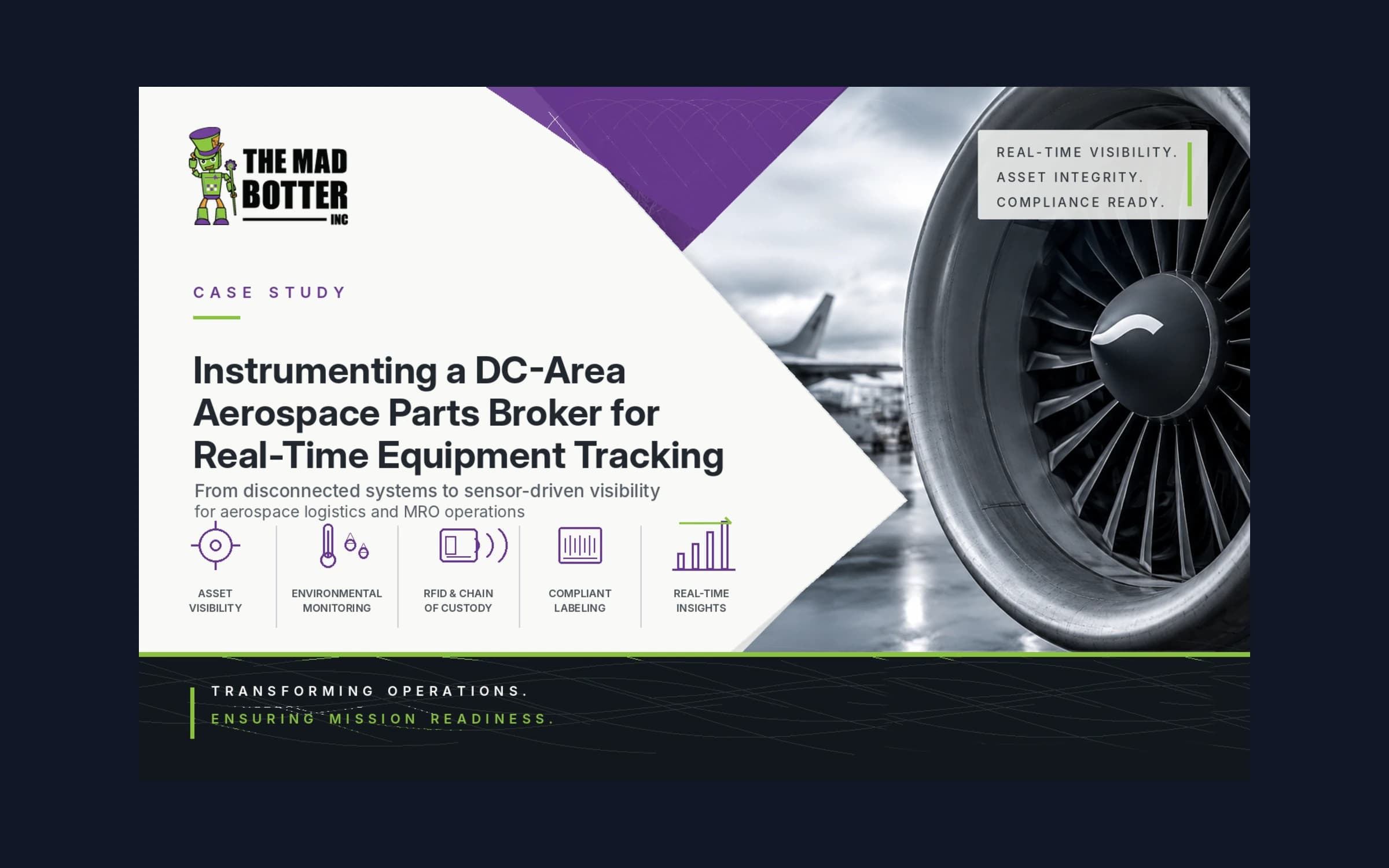
Case Study: Instrumenting a DC-Area Aerospace Parts Broker for Real-Time Equipment Tracking
Our client is a Washington, DC–area aerospace parts broker and repair-management (MRO) shop that supplies and overhauls components for defense and government customers — among them the Defense Logistics Agency, NATO, allied air forces, and international buyers across four continents. It's demanding, compliance-heavy work: every outbound shipment has to satisfy MIL-STD-129 marking rules and ITAR/EAR export controls, and much of the inventory is high-value, corrosion-sensitive hardware. As the business grew, its operations outgrew the tools running them. Day-to-day work was spread across fifteen Monday.com boards holding roughly 14,000 line items, a tangle of Google Sheets, a 1.6-terabyte shared document store, QuickBooks, and a library of hand-built Word and PDF templates. An order's history physically migrated from one board to the next as it aged — RFQ, to orders, to warehouse, to finance, to archive — and the boards were stitched together only by free-text reference numbers typed by hand. There was no single system of record, and no reliable way to answer a simple question: where is this part right now, and what condition is it in?
Challenge
The client had no live, physical visibility into its own assets. Parts and repair units moved between receiving, the warehouse, outside repair facilities, and customers, but that movement was tracked on paper labels, handwritten box counts, and spreadsheet rows that were stale the moment they were saved. High-value components sat in storage with zero monitoring of the temperature and humidity that drive corrosion and scrap — a risk that was completely invisible until damage showed up. RFID tags were peeled off a pre-printed spool and scanned into the DoD tracking system with nothing in the company's own records linking that tag to the job it belonged to. Compliance labels were produced by opening a third-party tool, screenshotting the output, and manually eyeballing the print scale — a self-described bottleneck on every shipment. The net effect was slow shipping, blind spots on both asset condition and location, and an operational memory scattered across a dozen disconnected systems that only a few people could navigate.
Solution
We built the client a customer-specific extension of the Vorpal ERP platform — a mountable Rails engine that makes Vorpal the single system of record and, critically, wires every asset to sensors and scanners. At the core is Vorpal's IoT layer: field gateways (BeagleBone Black and Raspberry Pi units connected over ethernet, Wi-Fi, or cellular) register themselves through a secured REST API, authenticate with rotating BCrypt-hashed keys, and stream temperature, humidity, pressure, vibration, and moisture readings on a configurable heartbeat into a time-series store. A rule engine evaluates every incoming reading against per-asset and per-equipment-type thresholds — greater-than, less-than, in-range, and "N consecutive breaches" conditions, each with its own cooldown — and raises severity-graded alerts (info, warning, critical) that fan out to email and Slack; a background health check flags any device that goes quiet and auto-clears the alert when it comes back online. All of this feeds a real-time dashboard that shows, at a glance, which devices are up, what every sensor is reading, and which alerts are open. On top of that instrumentation we replaced the manual tracking rituals with digital ones: RFID tag records now cross-reference the job, the MIL label, the shipment's Transportation Control Number, and the DoD scan; MIL-STD-129 labels generate as print-ready PDFs and stream straight to the warehouse's Zebra printers as ZPL with Code 128 and Data Matrix/PDF417 barcodes; monthly cycle counts are done by barcode scan against printed bin tags; and receiving is captured on structured checklists with a four-stage repair-photo record (incoming, out-to-repair, returned, shipped-to-customer). And because 14,000 records were imported out of those fifteen Monday boards into core Vorpal models, every document, shipment, label, and RFID tag now hangs off one relational job that keeps a single identity from quote to delivery.
Results
The client now operates from a live operational picture instead of a rear-view mirror, and the biggest gains are in equipment tracking. Every tracked asset carries a continuous condition-and-location record: the IoT dashboard updates in real time as readings and alerts arrive, so the team sees a problem as it develops rather than after it costs them. The single most valuable win is environmental monitoring of stored inventory — humidity and temperature alerts on parts-storage areas now warn of corrosion risk before high-value aerospace components are damaged, closing a gap that was previously invisible and unmanaged. Chain-of-custody is now unbroken: every asset move, check-out, and check-in is logged with location, timestamp, operator, condition, calibration state, and barcode scan, and each IoT gateway maintains its own independent location history — so an auditor can reconstruct exactly where a device or an asset has been. Preventive maintenance is scheduled off runtime hours and service intervals with full cost, vendor, and parts-replaced history attached to each asset, moving the shop from fix-it-when-it-breaks toward servicing on a cadence. Meanwhile the manual process holes are plugged end to end: the RFID-tag-to-job link that once lived only on a paper label is now a queryable digital record; the screenshot-and-scale labeling ritual is a one-click compliant print; handwritten inventory counts are barcode scans with automatic variance flagging; and the fifteen siloed boards are one relational source of truth. In short, the client went from tribal knowledge, paper, and stale spreadsheets to instrumented, sensor-driven equipment tracking — with the platform's anomaly-detection and predictive-maintenance capabilities positioned as the next step on the very same foundation.
Project Details
2026