Turning Equipment Data Into Operational Decisions
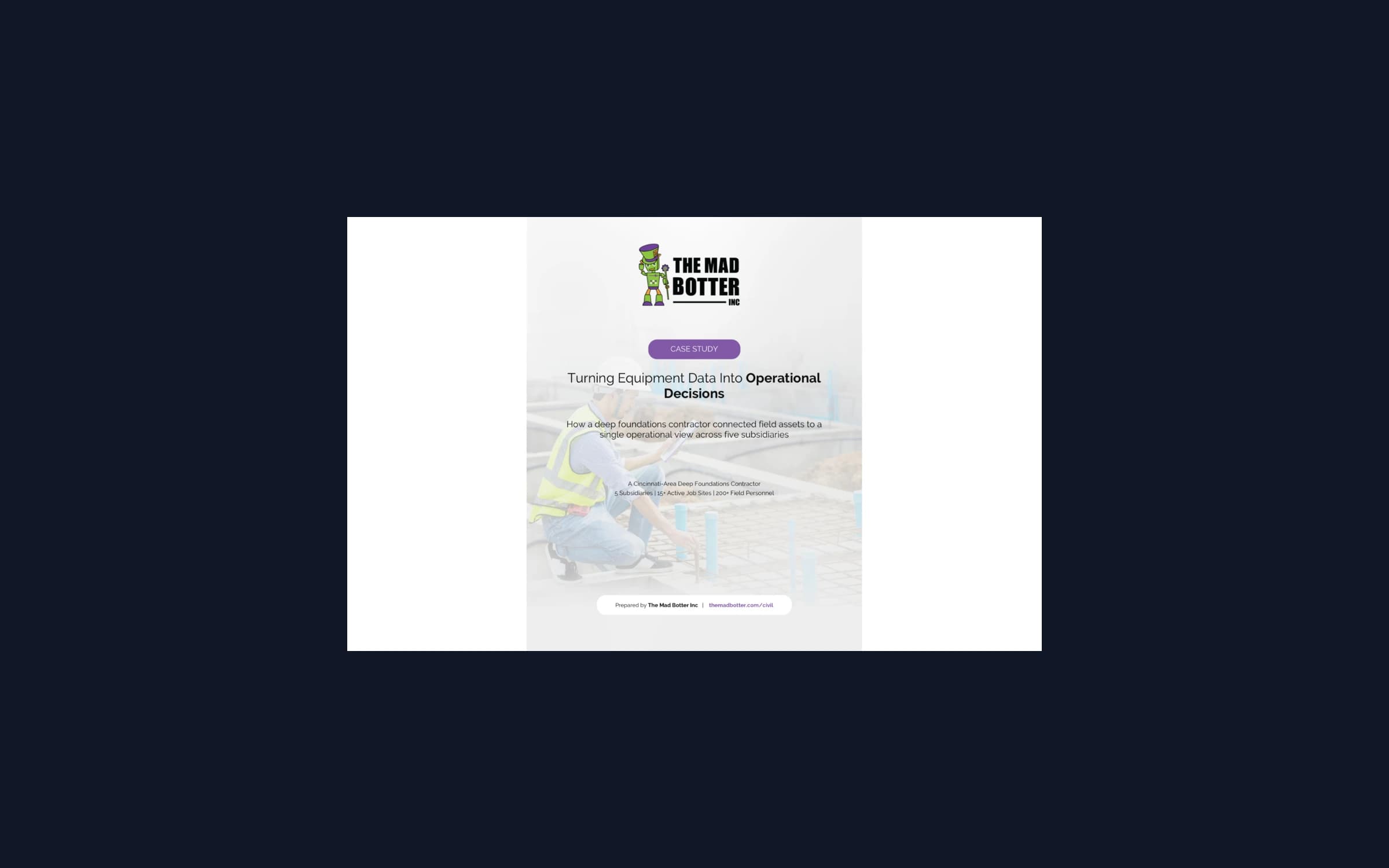
A Cincinnati-area heavy civil contractor specializing in driven piles, drilled shafts, micropiles, and earth retention. The company operates five subsidiaries across the Midwest, manages a mixed fleet of owned and rented heavy equipment, and runs 15 or more job sites simultaneously.
Challenge
The Challenge
Heavy civil contractors operate expensive, high-utilization equipment in punishing conditions. When a crawler crane sits idle because an inspection lapsed, or a drill rig moves between sites without anyone tracking its certification status, the financial and safety consequences compound quickly. This contractor faced a specific set of equipment visibility problems:
- No centralized view of equipment health, inspection status, or certification currency across the fleet. Each subsidiary tracked its own assets independently, if at all.
- Rental equipment from third-party suppliers arrived on-site with varying documentation. Inspection histories, certification dates, and maintenance records lived in binders in truck cabs or not at all.
- Equipment transfers between subsidiaries happened informally. A crane might move from a highway bridge project to a commercial foundation job with no record of when it left, when it arrived, or whether its inspections were current at the destination site.
- When OSHA or DOT inspectors arrived on-site, producing equipment certification histories required phone calls to the home office, where someone would dig through filing cabinets. The lag between request and documentation could stretch to hours.
- Leadership had no way to answer basic utilization questions: Which rigs are running? Which are idle? Where is the 200-ton crane right now? These answers lived in superintendents’ heads, not in any system.
Solution
The Solution The Mad Botter built a custom equipment operations layer that treats every piece of field equipment — owned or rented — as a first-class data object with a complete lifecycle:
acquisition or rental start, inspections, transfers, utilization, and disposition or return. Asset Identity and QR Tagging Every asset in the fleet received a unique identity in the system and a weatherproof QR tag affixed to the equipment. Scanning the tag pulls up the asset’s complete profile: type, specifications, current location, inspection history, certification status, and transfer log. This works for a 300-ton crawler crane and a portable generator alike. Inspection-Driven Compliance The system enforces inspection cadences appropriate to each equipment type. Crane inspections follow a different schedule and checklist than vibratory hammer inspections. When an inspection is due, the responsible superintendent sees it. When an inspection is completed in the field, leadership sees it immediately — not days later when paper arrives at the office. For rental equipment, the system tracks the supplier, rental period, inspection requirements, and return workflow. Third-party assets get the same inspection rigor as owned equipment. Transfer Workflow with Audit Trail Equipment transfers between sites or subsidiaries now go through a structured request- and-approval process. The request captures the asset, origin, destination, reason, and requesting superintendent. Supervisors approve or reject. Every transfer is logged with timestamps, creating the audit trail that was previously nonexistent. Fleet Visibility Dashboard Operations leadership can see the entire fleet in real-time: what is on which site, what is in transit, what has inspections due, and what is sitting idle. Automated daily summaries at 2:00 PM ET compile all equipment activity into a single report distributed to the operations team.
Results
Results Metric Result Equipment location visibility Real-time across 5 subsidiaries Inspection compliance tracking Automated by equipment type and cadence OSHA/DOT documentation response Instant (scan QR for full history) Equipment transfer audit trail Request → approve/reject with full logging Rental equipment tracking Supplier, inspections, and return workflow Idle equipment identification Visible to leadership in real-time Daily fleet status reporting Fully automated at 2:00 PM ET Cross-subsidiary asset sharing Structured workflow replaces phone calls Paper certification binders Eliminated Time to pull inspection history < 10 seconds (QR scan) Ready to modernize your field operations?
Project Details
2025