Should You Upgrade to Claude Opus 4.8? A Production Engineer's Read
What is Claude Opus 4.8?
Claude Opus 4.8 is Anthropic's flagship large language model, released on May 28, 2026, and positioned as its strongest option for coding, agentic tasks, and knowledge work. It keeps the same 1,000,000-token context window, 128,000-token maximum output, and January 2026 knowledge cutoff as Opus 4.7, so the gains come from the model itself rather than a larger context budget. Anthropic describes the release as a modest but tangible improvement, which is an unusually candid framing in a market saturated with generational hype. You access it via the claude-opus-4-8 API model ID, in claude, or on Amazon Bedrock. After a day of hands-on testing on real client codebases, our read is that it is a modest jump on paper and a clearly noticeable one in daily use.
How does Opus 4.8 compare to 4.7 on benchmarks?
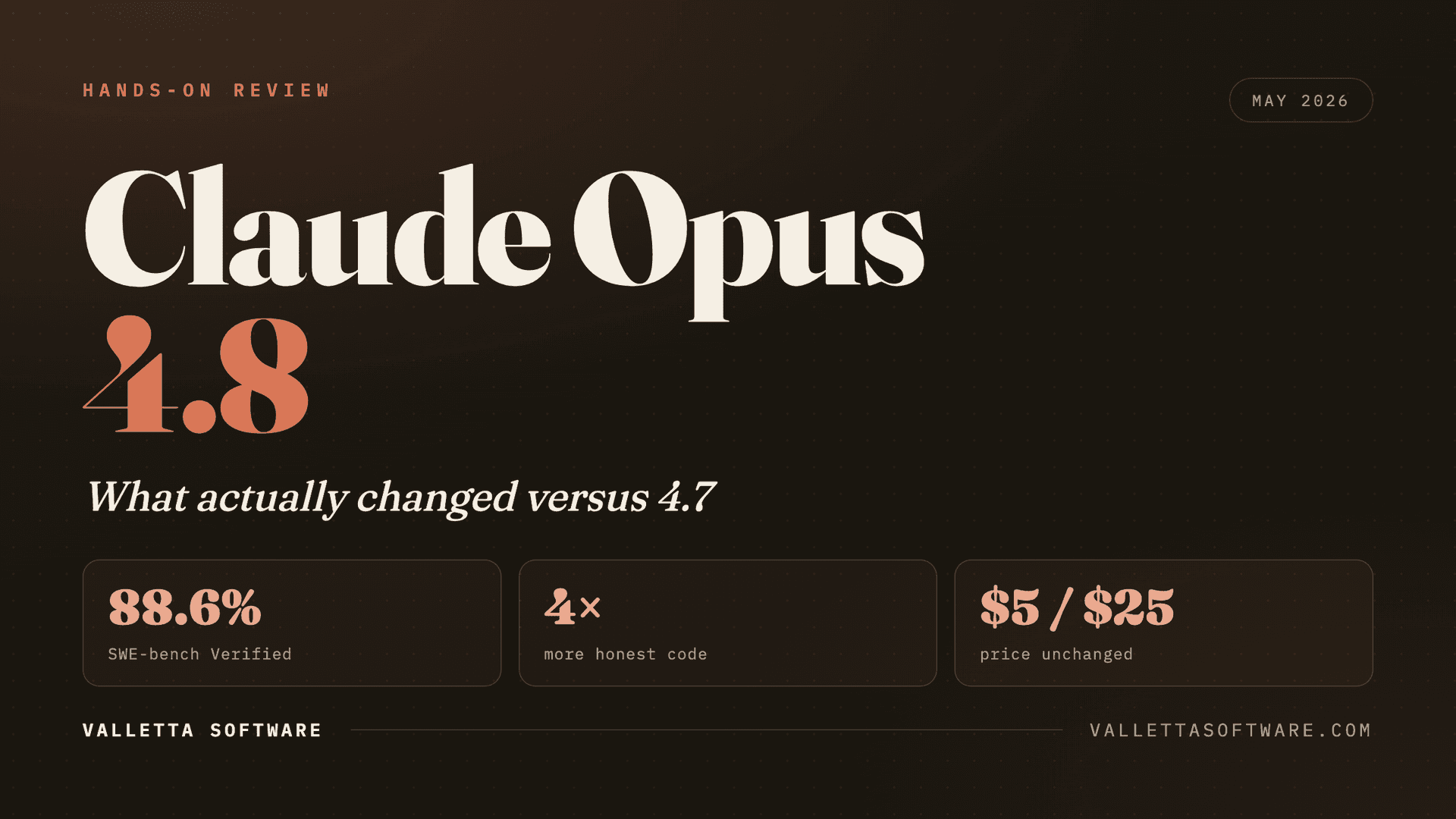
Every coding score moved up, and the largest gain landed on the hardest test. Opus 4.8 scores 88.6% on SWE-bench Verified versus 87.6% for 4.7, and 69.2% on SWE-bench Pro versus 64.3%. On SWE-bench Multilingual it reaches 84.4% against 80.5%. SWE-bench Pro is the variant that pulls from live repositories without leaked ground-truth answers, so it best resists memorization, and there Opus 4.8 lands almost 5 points ahead of 4.7 and more than 10 points clear of GPT-5.5 at 58.6% and Gemini 3.1 Pro at 54.2%. The gap is widest on long, multi-file changes inside repositories the model has never seen, which is exactly where production work lives. A point or two on Verified looks small, but on the harder Pro and Multilingual splits the lead compounds into measurably fewer broken pull requests across a sprint.
What actually changed in daily use?
Four things stood out. First, the model is more honest about its own code: it is roughly four times less likely than 4.7 to wave through a flaw in code it just wrote. Asked to fix a tangled bug, it laid out several tiers of related issues and proposed a regression-aware fix instead of patching the first symptom. Anthropic achieves part of this by having the model decline uncertain questions rather than bluff, which is the trade-off you want in production. Second, it pushes back instead of agreeing, making opinionated architecture calls on a CTO-style brief rather than asking permission at every step. Third, the reasoning is cleaner, with far less of the tangential noise 4.7 sometimes produced, which makes long agentic traces easier to audit. Fourth, two new capabilities ship alongside the model.
What are dynamic workflows and effort control?
Dynamic workflows, released as a research preview in Claude Code, let you put the word "workflow" in a prompt; Claude then writes an orchestration script on the fly and spins up a large fleet of coordinated subagents that run in parallel on complex tasks like repo-wide migrations and audits. It is available on Enterprise, Team, and Max plans. Effort control lets you dial how much computation Claude spends on a request, trading speed for depth. On the API side, system messages now work mid-conversation without breaking the prompt cache, and the minimum cacheable prompt dropped from 4,096 to 1,024 tokens, which quietly cuts cost in agent loops.
What does Opus 4.8 cost?
Standard pricing is unchanged from 4.7 at $5 per million input tokens and $25 per million output tokens. The bigger news is fast mode, which fell to roughly $10 per million input and $50 per million output, around a third of the previous fast-mode price.
Who should upgrade?
For coding and agentic work the upgrade is easy to recommend, especially because the price did not move. Teams running automated agents benefit most, both from the honesty gains and from the cheaper fast mode. The caveat is the same one that applies to every model in this class: pair it with a human review step. Some developers reported the model still hallucinating or skimming code on the most complex tasks, and the extra confidence can make a wrong answer sound certain. The last-10-percent problem on large legacy codebases has not vanished. Treat Opus 4.8 as a faster, more trustworthy collaborator, not an unsupervised one, and keep a reviewer in the loop. This is the same pattern we see in every audit of AI-built software: the model writes the bulk of the code, and an engineer handles the 30% where production actually breaks.