How to Build an AI Operating Platform for Professional Services Firms
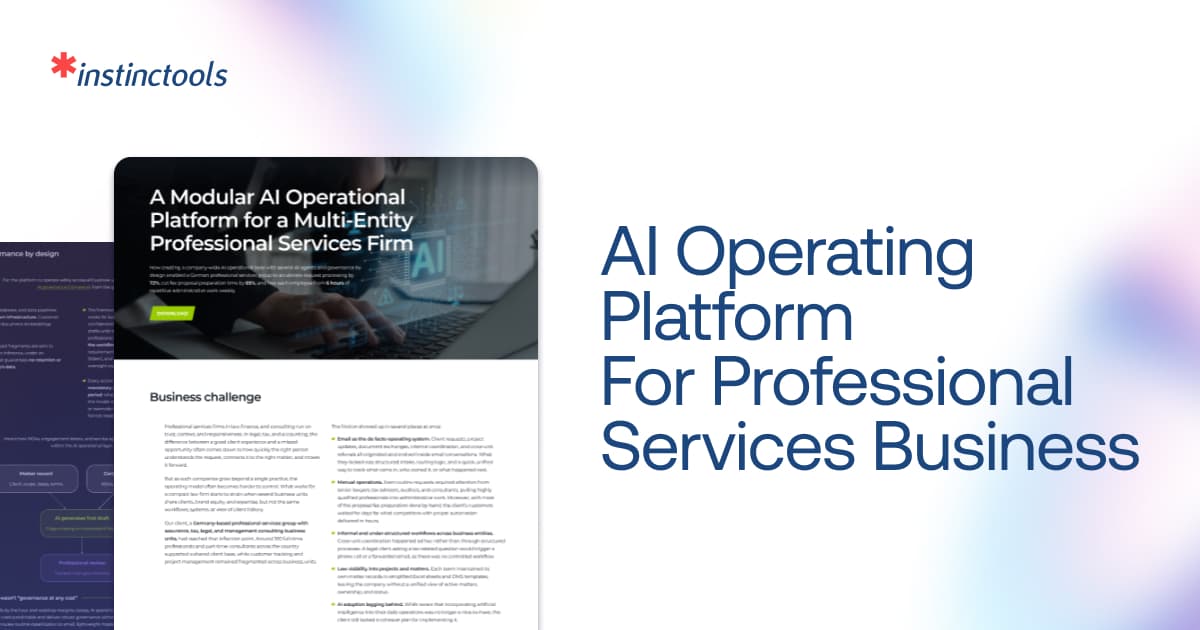
Professional services firms (legal, financial, accounting, tax consultants, and others) charge clients hourly for the knowledge and expertise of their employees. It is a literal illustration of the saying that time is money. At the same time, these firms pay their highly qualified employees for hours of routine work spent sorting through email, forwarding messages, and preparing responses and proposals for clients.
Our experience with professional services firms has shown that adopting AI can free up to 6 hours per week for an employee, speed up request processing by 72%, and cut the time needed to prepare a commercial proposal by 65%.
A typical AI adoption scenario for a professional services firm looks like this: the administrative work of handling requests starts consuming a lot of time. Employees manually sort incoming emails, figure out which department to forward them to, and who will take the request on. Administrative complexity grows as the company grows.
When Growth Outpaces Your Operating Model
Working on projects for professional services firms, we have identified bottlenecks that are typical across many companies:
Email is the company's operating system. All work happens in email: every client request arrives there, updates on current projects are stored there, and tasks are redistributed between employees in email threads. With this approach, it is very difficult to share context between the company's departments.
Senior experts spend their time on simple routine tasks. The highest-paid specialists do work below their level: collecting information, preparing documents, and other repetitive tasks instead of focusing on strategic priorities.
Preparing client proposals remains manual work. A person manually collects information from colleagues and from various systems to put together a commercial proposal for a client. This work can take days.
Collaboration between teams remains informal. Companies do not develop dedicated rules, standards, and policies for exchanging information between departments. Everything rests on personal communication, which is not always effective.
Important information is scattered across disconnected databases. This prevents the company from forming a complete picture of a client and their requests.
The company doesn't know how to adopt AI properly. Companies understand they need to adopt artificial intelligence, but they don't understand how and for what purpose, or what operating model for managing AI agents should be put in place.
At Instinctools, we address these challenges by building AI agent infrastructure on a unified operating platform – GENiE.
AI, Systems, and Human Expertise Working Together with GENiE
GENiE is a proprietary agentic AI framework developed by Instinctools. It lets you build the foundation once and then easily integrate and manage any AI modules: integration of additional models and services, context storage, agent orchestration, data and access management, and more.
In a professional services firm, such a controlled AI layer typically brings together mailboxes (it sorts and processes incoming email), document work, client matter data, internal systems, and decision-making processes. Everything is assembled into a single workflow with established rules and control.
At the same time, GENiE keeps AI-made decisions traceable and allows the final decision to be delegated to a competent person, so the company does not lose control over sensitive data.
Once implemented in a professional services firm, GENiE gives the business new capabilities:
- Unified AI governance with inherited rules. All governance, audit, and compliance rules are set at the platform level. Every newly deployed AI solution then automatically complies with these standards.
- A data platform with adapters. Ready-made connectors bring your document management system (DMS) or content management system (CMS), accounting software, Microsoft 365 services, and other systems together in one layer.
- Context synchronization between agents. All AI agents work with a shared context that includes information about clients, matters, and services. This helps avoid duplicate data entry and gradually enriches operational analytics.
With GENiE serving as an operational layer, including all integrations and governance, individual AI agents for defined roles can be added for specific business workflows and work in the same underlying business context.
In most professional services firms, AI agent adoption starts with processing incoming email, launching virtual assistants for employees, automating commercial proposal preparation, and customer support agents. Let's look at some of them in more detail.
Here are some examples we implemented in our recent clients’ projects.
AI-powered email sorting
Implementation: 2-3 weeks.
How it works: AI agents can take the routine out of handling email. Their capabilities make it possible to track new messages, read them and analyze their content, understand what the sender actually wants, and forward the message to the right specialist, with a deadline.
The advantage of AI agents is that they understand every language the business uses, including the vocabulary specific to your industry. Working closely with the client, our experts train AI agents to understand exactly this language, so that rules are precise and no important information is lost.
As a result, the company gets more than just tidy inboxes: it gets a fully functioning intake channel where requests turn into a structured workflow with a complete picture of current matters, the people responsible for them, and their status.
How to build an AI Agent-based Customer Support >
AI assistants for employees
Implementation: 2 weeks.
How it works: An AI agent can replace a live person in answering most administrative questions. HR policies, cost analysis, employee and client onboarding, access to IT infrastructure, or simply finding information in internal documentation: these are all tasks that artificial intelligence handles very quickly. And if human help is still needed, it always knows whom to contact.
Everything needed for a successful AI assistant launch is internal documentation that carries complete information. Our practice shows that an AI assistant can free up to 6 hours per week for employees.
AI-assisted preparation for commercial proposals
How it works: AI agents can take over all the routine involved in invoicing and preparing commercial proposals. For this, the system needs documentation on the company's current pricing policy. The agent then analyzes the text of the client's request, finds suitable services, and selects the expert who can solve the client's problem. AI takes on all the legwork of gathering information and coordination that used to take hours of work.
AI agent for expert support
Implementation: 4 weeks.
How it works: Experts often work with large volumes of data and documentation, including complex legal documents: contracts, legislation, regulatory requirements, and reporting. The AI agent's role is to study all the necessary documentation and prepare concise summaries, flagging inconsistencies or unresolved points. Every statement is backed by a reference to a specific document or paragraph. This way, the expert gets all the information needed to make a decision.
As a result, the business gets faster review of all documentation and saves an enormous amount of time that would otherwise go to manual analysis. Experts can focus on thoroughly analyzing the information and making a balanced decision.
From AI Agents to an Operating Model
The main value of an AI operational layer lies in a governed multi-agent system: many AI agents work in a shared context, support numerous integrations, and remain manageable.
An AI operational layer lets you connect additional agents and tools to the existing foundation without building separate standalone AI solutions. With this approach, the AI team grows together with the business.
If your company wants to move from scattered AI experiments to a governed AI operating model, reach out to Instinctools experts via the link.